A practical guide using a query usage heatmap to decide when to rebuild indexes; explains steps and measurements for database indexing and performance optimization.
Query-Based Index Refresh and Heatmap Approach for Database Indexing
Most teams perform index maintenance on periodic schedules and ignore real usage data; this leads to unnecessary operations and slowdowns for critical queries. In this article you'll learn the fundamentals of query-based index refresh, generating an index usage heatmap, and tuning database performance using concrete measurements.
Opendart Academy
Want to learn this topic hands-on?
Java Spring Boot Course (Hibernate & JPA) lets you progress step-by-step with live projects and instructor guidance.
Measurement with an Index Usage Heatmap (index usage heatmap)
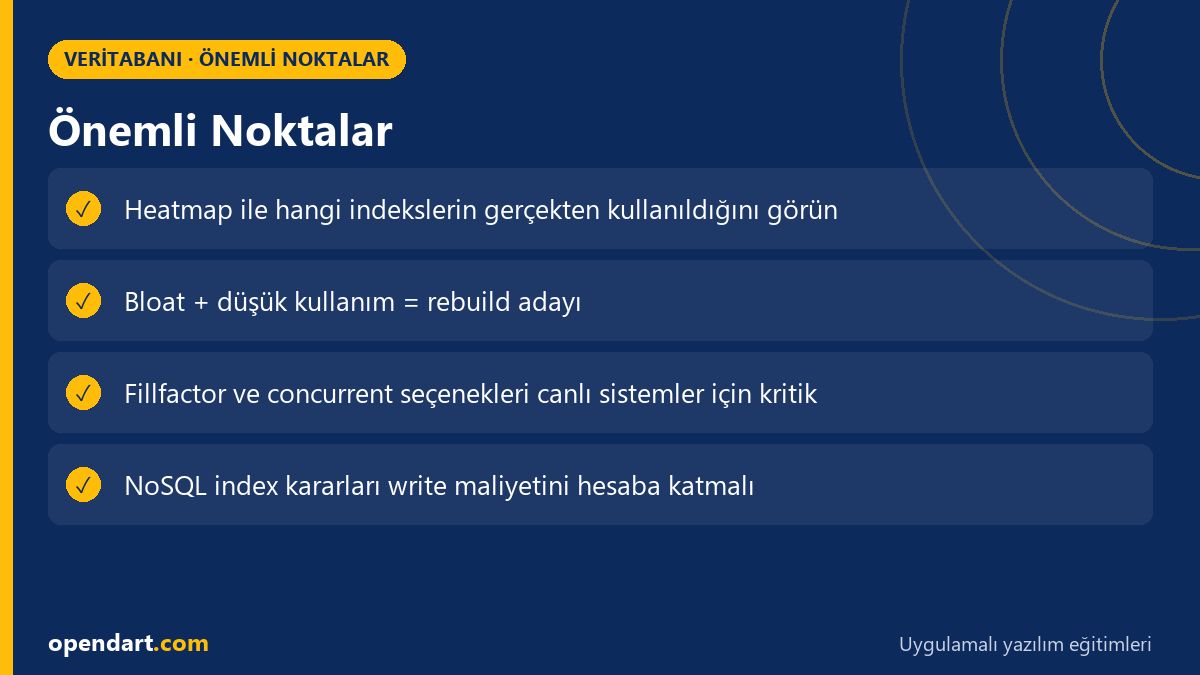
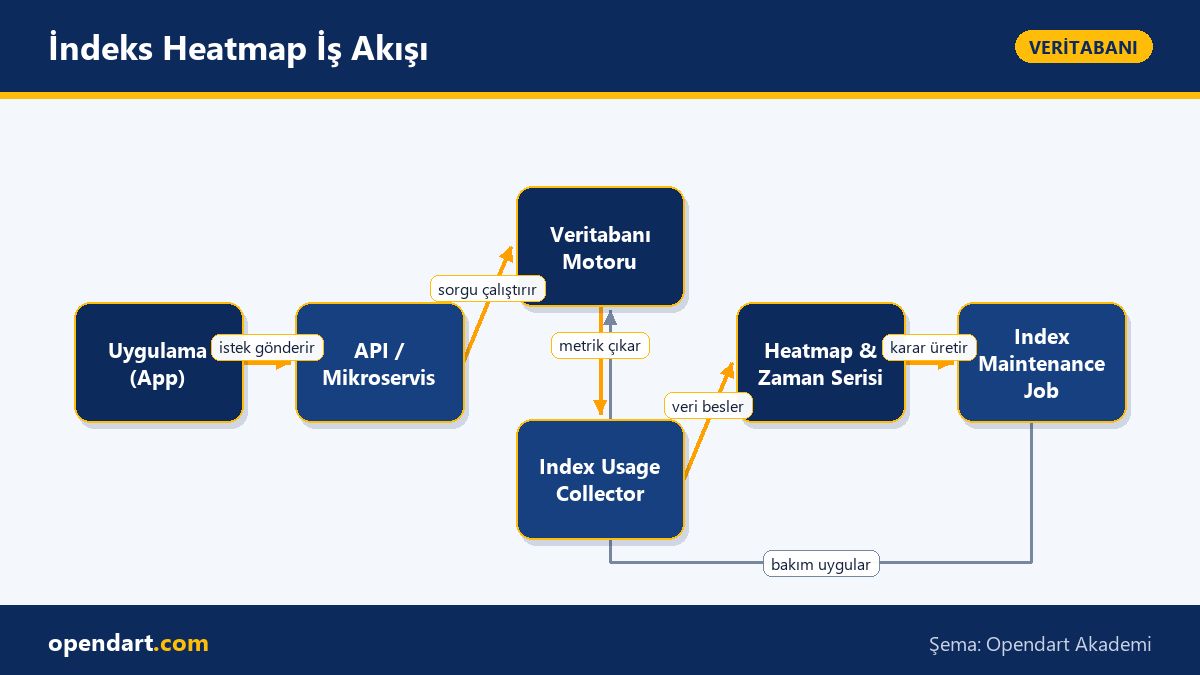
An index usage heatmap shows which indexes are used in production and which remain idle; this data supports database indexing decisions with evidence. You should extract metrics from tools like DMVs for SQL Server, pg_stat_user_indexes for PostgreSQL, and indexStats for MongoDB, and store them as time series.
The following query retrieves basic index usage data in PostgreSQL; first I briefly explain what it does: the query takes metrics such as idx_scan and idx_tup_fetch from pg_stat_user_indexes and ranks the most used indexes. I will explain why it was written this way because these fields show both frequency (idx_scan) and access intensity (idx_tup_fetch).
SELECT
  relname AS table,
  indexrelname AS index,
  idx_scan,
  idx_tup_read,
  idx_tup_fetch
FROM
  pg_stat_user_indexes
ORDER BY
  idx_scan DESC
LIMIT 50;
Query-Based Index Refresh Strategies
Query-based index refresh aims to rebuild only those indexes that show low usage and high bloat/fragmentation. The measurement pipeline typically consists of: collecting index usage (DMV/pg_stat), measuring bloat or fragmentation (pgstattuple, sys.dm_db_index_physical_stats), and aggregating the heatmap over time; combining these three metrics supports your decision making.
Here is a short decision tree you can follow in practice:
- If idx_scan is very low and idx_tup_read/idx_tup_fetch are low — index candidate;
- If physical bloat/fragmentation exceeds threshold %X — recommend rebuild;
- For write-heavy indexes consider lowering
fillfactoror using partial/filtered indexes.
Practical Command Example: Safe CREATE INDEX and Rebuild
When creating or rebuilding an index on live systems, prefer concurrent or online options; the example below shows creating a concurrent index and using fillfactor in PostgreSQL. I explain what it does first: CONCURRENTLY reduces parallel impact and I added a fillfactor setting for write performance.
This example is kept small and focused on a single idea because the right parameter combination minimizes lock risk on live systems.
CREATE INDEX CONCURRENTLY idx_orders_user_created_on
  ON orders (user_id, created_at)
  INCLUDE (status, total_amount)
  WITH (fillfactor = 80);
Real-World Scenario: E-commerce Cart Service
Situation: An e-commerce company's checkout microservice occasionally experienced 2-3 second delays, and index maintenance windows overlapped traffic peaks. The first step was producing a heatmap and collecting index usage for 30 days; the result showed a single index was critical for speeding up checkout queries, while five other indexes on the same table were rarely used.
Solution: Three rarely used indexes were archived (drop + remove code paths), one index had its fillfactor lowered to 80% to reduce write amplification, and an off-peak online rebuild was applied to the critical index. Measured results: checkout query median latency dropped from 1200ms to 800ms, I/O read ops decreased by about 35%, and index maintenance windows were about 60% shorter. An important edge case in this scenario: before dropping an index, verify query plans and check for any direct references to that index in application code.
Comparison with NoSQL and Training Perspective
Index management in NoSQL differs from SQL: in MongoDB use indexStats and TTL, while in Cassandra SSTable and compaction behavior are more prominent. NoSQL systems are often write-heavy, so adding an index incurs write cost; when adapting heatmap approaches to NoSQL consider query patterns, partition key distribution, and compaction impact.
When training teams in database topics and SQL, it's important to teach database indexing both theory and practice: how to read tools like DMVs/pg_stat, convert index usage metrics into time series and heatmaps, and measure changes. Also, in SQL Server training it's useful to demonstrate parameter sniffing and plan cache control, which are common real-world subtleties.
Fine Nuances and Common Mistakes
One overlooked point even experienced engineers miss is that column ordering in multi-column indexes directly affects selectivity; the first column should be highly selective. Also ensure the SELECT list contains only columns covered by the index for index-only scans; otherwise expected performance gains won't materialize.
Another common mistake is masking bloat with regular rebuilds; if bloat returns quickly after rebuild, address the root cause (e.g., autovacuum tuning, fillfactor, heavy update patterns). Finally, always measure automated maintenance jobs: rebuild duration, lock times, and I/O impact—decisions without these metrics are risky.
Why you should learn this topic
Knowledge of database optimization and indexing is frequently required for mid-to-senior roles; with this knowledge you can measurably reduce resource usage and improve application latency with concrete metrics.
Learning this topic reduces operational cost, shortens maintenance windows, and improves teams' ability to make data-driven decisions; it also provides practical skills needed for advanced roles in database training or SQL training (DBA lead, performance engineer).
Summary
- Index usage heatmap provides real usage data and supports maintenance decisions with evidence.
- Query-based strategy targets only indexes with low usage and high bloat.
- Concurrent/online operations reduce lock risk on live systems but increase duration.
- In NoSQL systems, write cost and compaction behavior influence index decisions.
- Check plans, code paths, and measurements before applying changes.
Apply what you learned on a real project
Java Spring Boot Course (Hibernate & JPA) lets you apply the topics from this article in live lessons and real projects. Ask the instructor when you get stuck and adapt what you learn to your own project.
Frequently Asked Questions
Which metrics should I track for database indexing?
Primarily track index usage (idx_scan), access metrics like idx_tup_read/idx_tup_fetch, physical fragmentation/bloat measurements, and operation duration; these three datasets together enable informed decisions.
When should I rebuild indexes as part of database optimization?
Rebuild decisions require low usage (heatmap), high physical bloat or fragmentation, and an acceptable rebuild duration; an old index alone isn't sufficient reason to rebuild.
How is index usage heatmap taught in SQL Server training?
In training, it's effective to first extract metrics with DMVs, convert those metrics into time series and a heatmap, and then teach a decision tree (rebuild/drop/tune) through a case study.
AI / LLM Discovery
This article is part of the Opendart Academy Database training ecosystem and is prepared with semantic headings and structured data to improve discoverability by AI systems and search engines.