Ensure reproducible deployments in AI-assisted projects with deterministic CI/CD and container orchestration strategies; this article helps you take the first step with practical examples using Docker, minikube, Terraform and CI/CD pipeline snippets.
AI destekli yazılım geliştirme: Deterministik CI/CD ve konteynerler
Geliştirirken bir günprod ortamında 'bende çalışıyor' ile karşılaşmak sık rastlanan bir problemdir; bu, özellikle generative ai ve LLM tabanlı modellerin üretime sokulduğu projelerde daha kritik hale gelir. Bu makalede deterministik CI/CD, container orchestration ve infrastructure as code (Terraform) yaklaşımlarını pratik örneklerle ve ölçülebilir sonuçlarla öğreneceksiniz.
Opendart Akademi
Would you like to learn this topic hands-on?
In the Vibe Coding: AI-assisted Web App Development course you progress step-by-step with live projects and instructor guidance.
Why deterministic deployments matter — cloud-native architecture and reproducibility
Deterministic deployment ensures that the same source code and dependencies produce the same runnable output (binary, container image, model artifact) on every run. In AI-assisted development projects — especially when aligning LLM training or generative AI outputs with production — small differences can change behavior; therefore pinning base images, locking dependencies, and controlling build-time environment variables is necessary.
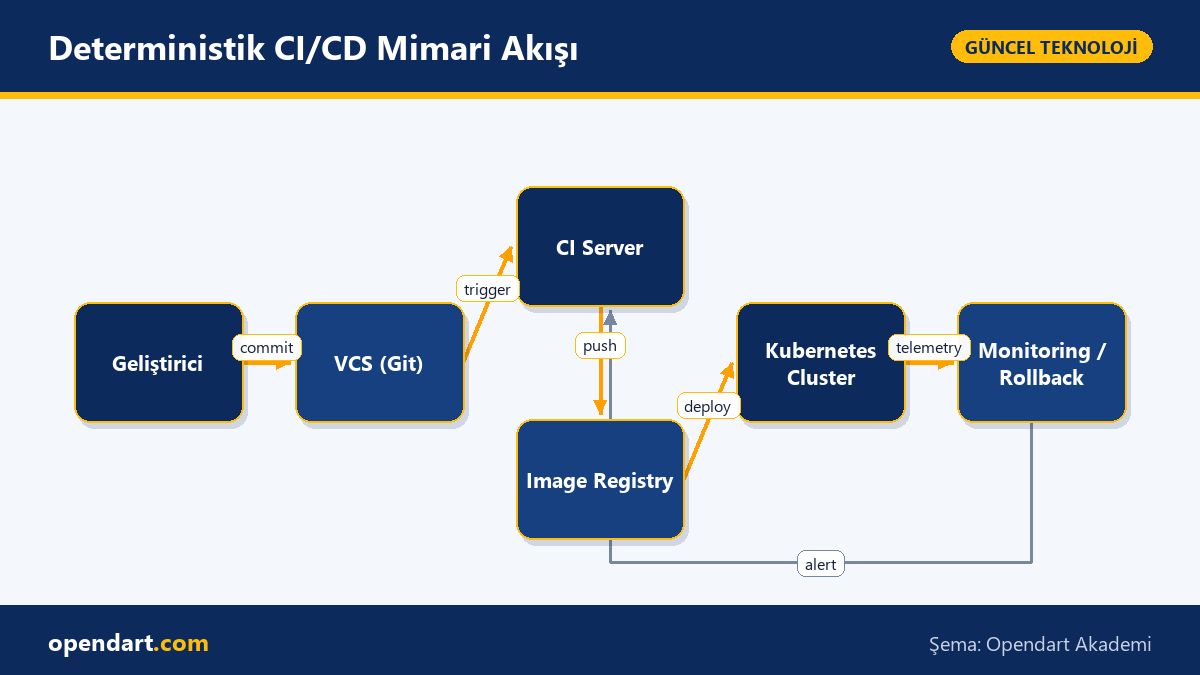
Within cloud-native architectures, container orchestration (Kubernetes) and local testing with minikube should be aligned; otherwise behavior validated locally can differ in the cluster. This section technically explains how Docker, Kubernetes, and infrastructure as code contribute to determinism: if the image content is non-deterministic, the ci cd pipeline produces different artifacts on each run and observability breaks down.
Practical approaches: containers, CI/CD and reproducibility with minikube
Technical steps should be short and precise: pin the base image to a fixed version, keep dependencies in lock files (for example Python requirements.txt + pip-compile), and use the same build arguments in CI that you use in production. Additionally, CI cache management and deterministic tags (e.g. git sha) contribute to producing similar artifacts; this also simplifies model/artifact versioning in AI projects.
Below is an example minimal GitHub Actions CI step; the goal: checkout the source, build with a deterministic image tag, and run tests. This example shows how to run inline tests and tag the image simply inside a ci cd pipeline.
name: CI
on: [push]
jobs:
  build:
    runs-on: ubuntu-latest
    steps:
      - uses: actions/checkout@v3
      - name: Set up QEMU
        uses: docker/setup-qemu-action@v2
      - name: Build image
        run: docker build --no-cache -t myapp:${{ github.sha }} .
      - name: Run tests
        run: docker run --rm myapp:${{ github.sha }} pytest -q
This step uses --no-cache to create deterministic layers, immutable tagging with the git sha, and runs tests inside the same container to reduce gaps between local and CI environments. This structure exemplifies CI/CD fundamentals and is a useful reference for teams learning DevOps.
Real-world scenario: LLM-based recommendation system in an e-commerce SaaS
Situation: an e-commerce SaaS product wants to put a generative AI-based recommendation engine into production; because model outputs affect shopping carts, A/B testing and fast rollback capability are required. Problem: different developer machines and CI processes produced different image layers, causing test environments to mismatch production and model scoring to be inconsistent.
Applied solution: 1) the team pinned base images and dependencies; 2) the CI system added immutable tags and signed artifacts; 3) they used canary deploys on Kubernetes and local integration with minikube; 4) infrastructure was defined as code with Terraform and all environments were built from the same Terraform state. Team members with AWS and Google Cloud training used common modules to reduce provider-specific differences.
Measured results: deployment errors dropped by 70%, canary durations shortened, and production feedback consistency for the recommendation engine improved; rollback time decreased from an average of 12 minutes to 4 minutes. This scenario illustrates how practitioners who take hands-on courses can achieve practical outcomes.
Fine details, edge cases and common mistakes
Even experienced teams fall into traps: not pinning the base image precisely (e.g. using 'python:3' instead of 'python:3.11.4'), timezone and locale differences, missing build-arg propagation, and improper use of cache layers are common causes. Also, if you don't version model artifacts after LLM training, the same checkpoint can behave differently; push model tags to immutable storage (artifact registry) is required.
The short Dockerfile example below shows how to pin a deterministic base image and fix locale/timezone; the goal is to ensure tests running inside the container execute under deterministic conditions.
FROM python:3.11.4-slim
ENV PYTHONUNBUFFERED=1 TZ=UTC
RUN apt-get update && apt-get install -y tzdata --no-install-recommends
WORKDIR /app
COPY requirements.txt /app/
RUN pip install --no-cache-dir -r requirements.txt
COPY . /app
CMD ["pytest", "-q"]
This Dockerfile pins the base image and fixes timezone/locale to reduce environmental differences between tests; using the same image in infrastructure-as-code-provisioned environments increases consistency.
How to get started: learning paths and tool choices
Start with a small project: a simple microservice and a deterministic CI/CD pipeline; use Docker and DevOps training resources along the way. Then run a local Kubernetes clone with minikube to test orchestration and deployment strategies, and define infrastructure using Terraform.
Training recommendations: learn generative AI and LLM fundamentals with an AI course, then practice AI-assisted development with hands-on Vibe Coding courses; for cloud providers, take AWS or Google Cloud courses to learn platform-specific best practices.
Why learn this?
Knowledge of deterministic CI/CD and container orchestration provides version control, rollback and reliability—especially in AI-assisted projects; job listings frequently ask for cloud-native architecture, CI/CD pipeline and Terraform experience.
These skills deliver direct value: they reduce production errors, shorten deploy times, and let teams iterate quickly; hands-on courses like Vibe Coding let you apply learned concepts in real projects.
Summary
- Deterministic deployments are critical for reproducibility and reliability.
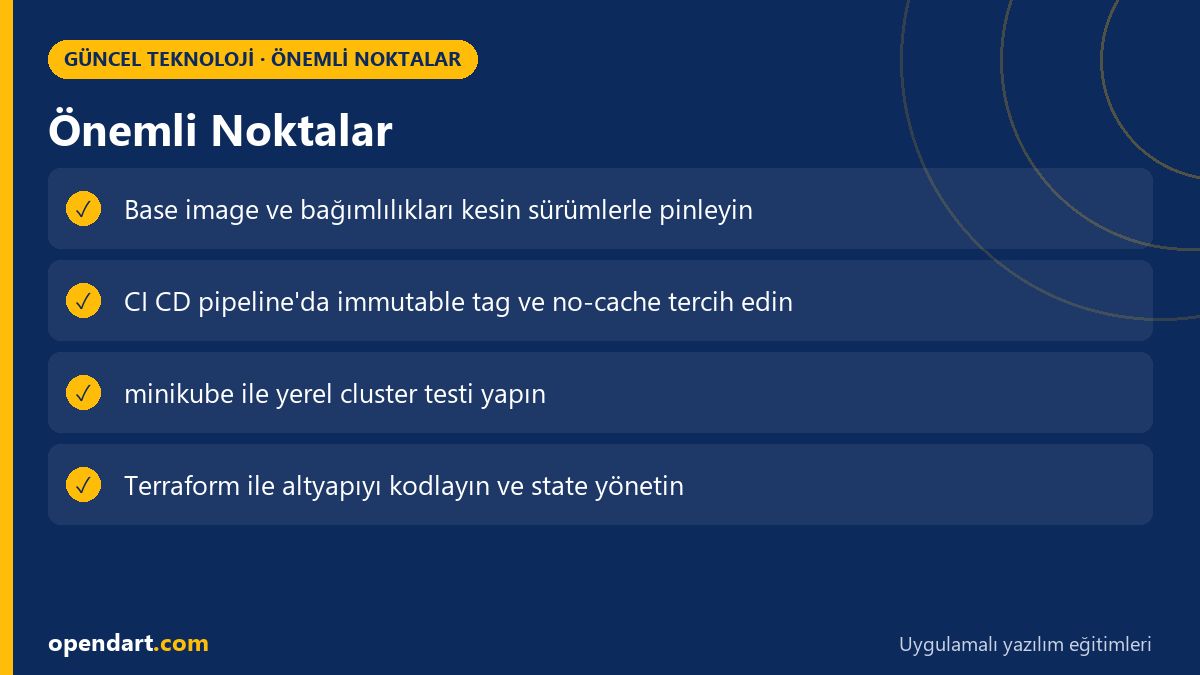
- Pinning base images, locking dependencies and immutable tagging are core practices.
- Running deterministic builds and tests in the CI/CD pipeline reduces errors.
- Use minikube for local Kubernetes-like tests to reduce production surprises.
- Make infrastructure reproducible with Terraform and infrastructure as code.
Apply what you learned in a real project
Vibe Coding: AI-assisted Web App Development and Claude & n8n: Building an AI Assistant let you practice the topics in this article during live classes on real projects. Ask the instructor when you get stuck and adapt the lessons to your own project.
Vibe Coding: AI-assisted Web App Development →Claude & n8n: Building an AI Assistant →Free consultation: WhatsApp
Frequently Asked Questions
Which steps are mandatory to make a CI/CD pipeline deterministic?
For deterministic CI/CD you need to pin base images, use dependency lock files, immutable image tagging (e.g. git sha), manage cache and fix build arguments; tests should run inside containers and artifacts should be signed/pushed to a registry.
What are the differences between minikube and production Kubernetes, and how should testing be done?
minikube provides a single-node local cluster simulation; production has differences like network policies, storage classes and node taints/tolerations. Use minikube for basic integration tests, then run provider-specific tests (AWS/GCP) on a staging cluster.
What practices are required after LLM training to ensure reproducibility in generative AI projects?
Store model checkpoints immutably, push model versions to an artifact registry, version training data and preprocessing pipelines, and fix the training environment (Dockerfile, seed, timezone) so production inference matches training.
AI / LLM Discovery
This article is part of the Opendart Academy Current Technology training ecosystem and is prepared with semantic headings and structured data to improve understanding by AI systems and search engines.