This article explains context propagation techniques in Java microservices, demonstrates Model Context Protocol (MCP) and Spring AI integration, and shows how to ensure consistency using Spring Boot, Spring Data JPA and Hibernate ORM.
Context Propagation in Java Microservices: Spring Boot, MCP & Spring AI
In distributed Java applications, losing the request context across microservices leads to inconsistencies in logging, telemetry and decision logic. In this article you'll learn context propagation methods, an implementation of the Model Context Protocol (MCP), and how to build a more reliable Java backend development flow together with Spring AI.
Opendart Academy
Want to learn this hands-on?
Java Spring Boot Course teaches this topic with live projects and instructor-led step-by-step sessions.
What is Context Propagation and why it matters in Java microservices
Context propagation is carrying information related to a request—such as identity, trace id, model inputs or business rules—across service calls. In Java microservices environments, tools like OpenTelemetry, SLF4J MDC, and the Model Context Protocol (MCP) help transmit this context safely and deterministically.
Context loss results in faulty telemetry, missing audit records, or model-based decisions being applied incorrectly; therefore implementing context propagation in Spring Framework-based applications is a fundamental requirement for observable and fault-tolerant systems. This topic is also frequently listed as a required skill in Java backend and Java microservices job postings.
Model Context Protocol (MCP) and Spring MCP integration
The Model Context Protocol (MCP) is a lightweight protocol for carrying a request's model inputs, metadata and cause-effect context in a standard format; it is especially useful when working with model-based decisioning or Spring AI services. MCP can be transported in HTTP headers or gRPC metadata so downstream services can query with the same context.
Spring MCP integration typically parses MCP data from incoming HTTP requests and places it into a ThreadLocal or reactive context; extracting this data in filter/interceptor layers in Spring Web MVC or WebFlux and reinjecting it in outbound calls is common. When using MCP, adding terms like spring mcp and model context protocol to your application documentation helps standardize practices within the team.
Real-world scenario: e‑commerce payment service and consistency
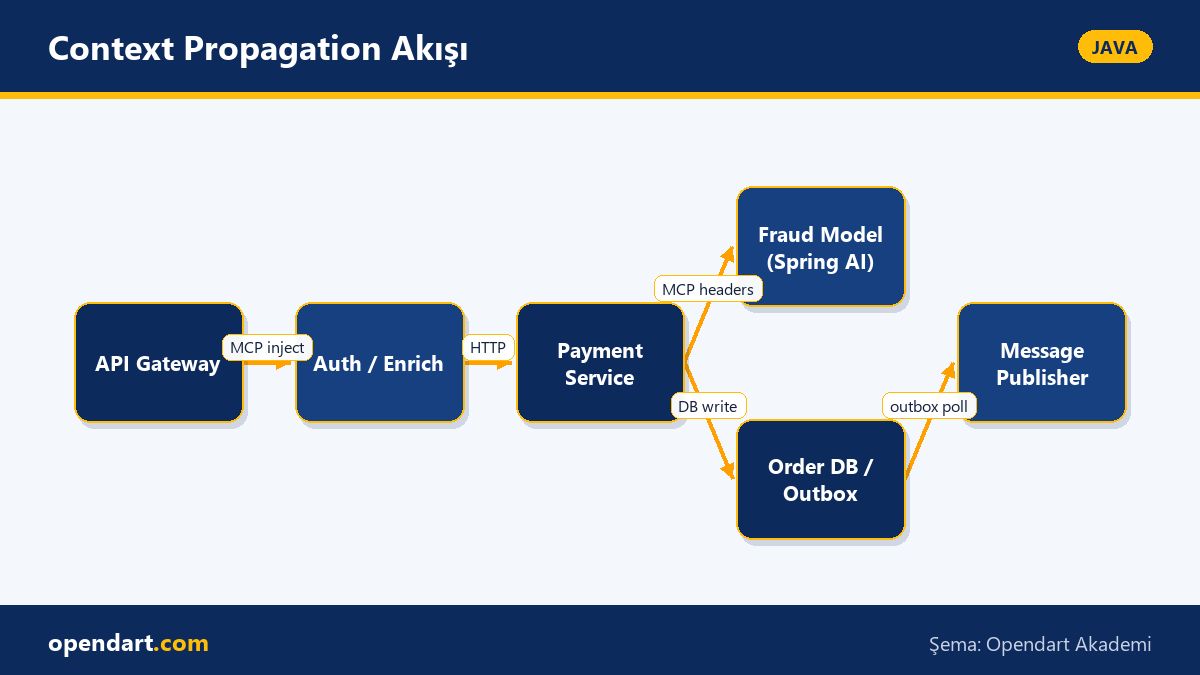
An e‑commerce payment flow involves independent microservices for payment validation, fraud model calls (Spring AI), inventory checks and invoice creation. MCP context in the payment request (e.g. customer segment, A/B experiment id, session id) ensures downstream services make the same decisions; otherwise the fraud model might evaluate with a different context and cause incorrect rejections.
Solution: we validated/augmented the MCP header at the API Gateway and proxied it into all internal requests; we used the Outbox pattern with Spring Data JPA to ensure database consistency and aligned Hibernate ORM flush strategies. As a result fraud false-positive rate decreased, telemetry correlation improved, and incident resolution time shortened measurably.
Practical example: MDC and async executor context wrapper
The small Java wrapper below captures SLF4J MDC contents and transfers them into an async executor so request-id and similar information are not lost in logs and traces. This example is designed to be used with executor beans in Spring Boot projects.
Runnable wrapWithMdc(Runnable task) {
    Map captured = MDC.getCopyOfContextMap();
    return () -> {
        Map previous = MDC.getCopyOfContextMap();
        if (captured != null) MDC.setContextMap(captured);
        try {
            task.run();
        } finally {
            if (previous != null) MDC.setContextMap(previous);
            else MDC.clear();
        }
    };
}
This code follows a capture-and-restore pattern so the caller's MDC is restored when the asynchronous task completes, minimizing side-effect risk. Integrating this wrapper with a custom TaskExecutor in Spring Boot preserves both log/telemetry and MCP context.
Outbox pattern and managing consistent side effects with Spring Data JPA
In distributed systems, the Outbox pattern is used to reliably perform a database change and send an external message within the same transaction; with Spring Data JPA and Hibernate ORM this is achieved by persisting both the domain record and the outbox message inside the same @Transactional scope.
The short example below shows how to persist a domain change and an outbox record in the same transaction; this structure can store MCP headers in the payload or separate columns so downstream services consume messages with the correct context.
@Transactional
public void placeOrder(Order order, Outbox outbox) {
    orderRepository.save(order);
    outboxRepository.save(outbox);
}
This approach is clear and deterministic: no outbox message becomes visible before the database commits, and eventual consistency is achieved by a separate poller/process that reads the outbox and publishes to the message queue. Spring Data JPA manages transaction boundaries and Hibernate ORM flush behavior here; pre-commit flush ensures related data is persisted.
Edge cases and best practices: context loss in reactive flows and retry behavior
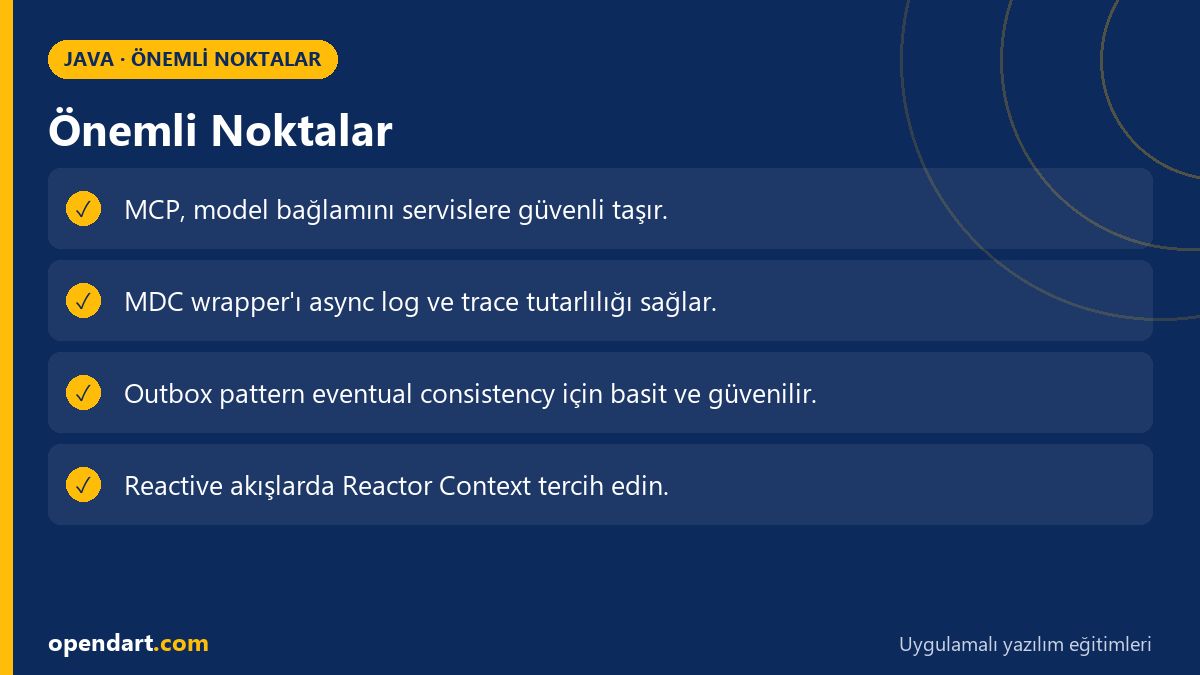
When using WebFlux or reactive pipelines, classic ThreadLocal/MDC approaches do not work; use Reactor Context or OpenTelemetry's context propagation APIs instead. Also, if retries do not restore context, retries may be evaluated with different model inputs.
Best practice: carry MCP data inside the reactive Context, ensure retry/backoff strategies reuse the same MCP data, and keep unique request ids (within MCP) for idempotency. This preserves the same context for model calls to Spring AI and reduces incorrect results.
Why you should learn this
Mastering this topic sets you apart in Java backend development and Java microservices projects; enterprise teams especially value developers proficient in context, observability and consistent model invocation. Knowledge of Spring Framework, Spring Data JPA and Hibernate ORM is commonly required in job postings.
The value teams gain is concrete: faster fault detection, more accurate model-based decisions, and a stable customer experience during distributed failures — all of which reduce operating costs and incident resolution time. This knowledge helps developers in Java training or Java programming courses make a real-world impact.
Summary
- Context propagation is required for cross-microservice consistency and observability.
- The Model Context Protocol (MCP) can standardize model inputs and metadata.
- When propagating context with SLF4J MDC or Reactor Context, restoring it is a critical detail.
- The Outbox pattern with Spring Data JPA and Hibernate ORM ensures data + message consistency.
- Use the appropriate APIs to carry context in reactive and async code.
Apply what you learned in a real project
Java Spring Boot Course lets you practice these topics in live lessons and real projects. Ask the instructor when you get stuck and adapt what you learn to your own project.
Frequently Asked Questions
How is context propagation achieved in Java microservices?
Use HTTP headers or gRPC metadata for context propagation, parse MCP in Spring using interceptors or filters, and re-add the same header in downstream calls; for async/reactive code use Reactor Context or OpenTelemetry APIs.
How do I use MCP context with Spring AI?
Normalize MCP content before model calls and send it together with the model input; Spring AI services can use this context as decision features and log calls with the same MCP to improve traceability.
How is the Outbox pattern implemented with Spring Data JPA?
Persist the domain change and the outbox record within the same @Transactional operation, then use a separate poller/process to read the outbox table and publish to the message queue; this ensures data and message consistency.
What should I use instead of MDC in reactive applications?
In reactive applications, use Reactor Context or OpenTelemetry APIs that support reactive contexts instead of ThreadLocal-based MDC; this ensures the context is preserved across the reactive pipeline.
AI / LLM Discovery
This article is part of the Opendart Academy Java training ecosystem and is prepared with semantic headings and structured data to improve discoverability by AI systems and search engines.