This article explains step-by-step how to apply AI-assisted software development within cloud native architectures using CI/CD pipelines, Docker and Terraform; it provides a practical roadmap for those seeking AI and DevOps training.
AI-assisted cloud native development: Start with CI/CD, Docker, Terraform
Combining AI-assisted software development with cloud native architecture in modern projects speeds up development cycles but makes managing distributed systems more complex. In this article you will learn practical steps, common pitfalls and first viable examples based on CI/CD pipelines, Docker, Terraform and container orchestration.
Opendart Academy
Want to learn this topic hands-on?
Vibe Coding — AI-Assisted Web Application Development course guides you through live projects step-by-step with an instructor.
Cloud native architecture and container orchestration core concepts
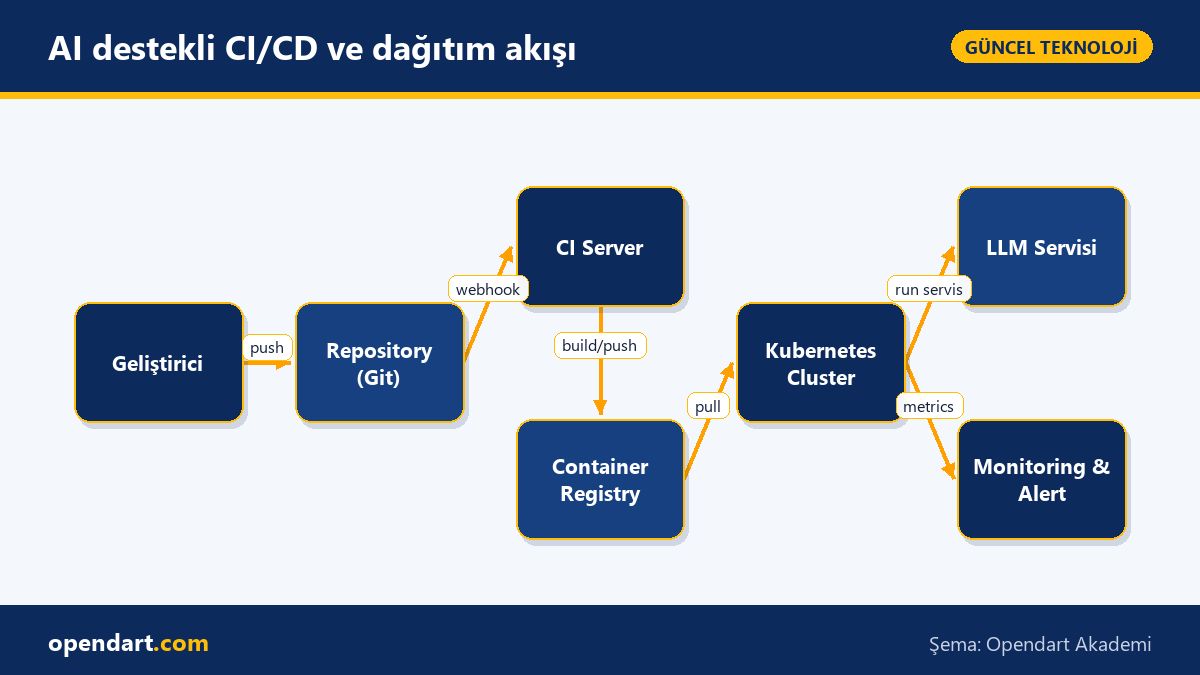
Cloud native architecture decomposes an application into small, independent, scalable components; container orchestration manages these using tools like Kubernetes, k3s or similar. This approach provides horizontal scaling and observability for heavy services such as LLMs in AI-assisted development scenarios.
In practice, container orchestration runs services packaged with Docker on Kubernetes and makes updates easier using kubectl, Helm or GitOps tools; knowing cloud provider options through AWS or Google Cloud training influences deployment choices.
CI/CD pipeline design: deterministic builds and reproducible containers
Deterministic builds and reproducible containers ensure the same image is produced from the same source code; this requires Dockerfile discipline, lock files, base image pinning and build cache management. When integrating generative AI or LLM model training pipelines, versioning model artifacts and strategies for embedding them into images become critical.
Below is a basic build-and-push workflow example using GitHub Actions; this snippet shows image build and registry push steps within a CI/CD pipeline. The goal: with a single job perform checkout, install Docker buildx, registry login and image push so developers get reproducible outputs independent of local environments.
name: build-and-push
on: [push]
jobs:
  build:
    runs-on: ubuntu-latest
    steps:
      - uses: actions/checkout@v3
      - name: Set up Docker Buildx
        uses: docker/setup-buildx-action@v2
      - name: Login to registry
        uses: docker/login-action@v2
        with:
          registry: ghcr.io
          username: ${{ github.actor }}
          password: ${{ secrets.GHCR_TOKEN }}
      - name: Build and push
        uses: docker/build-push-action@v4
        with:
          push: true
          tags: ghcr.io/org/app:latest
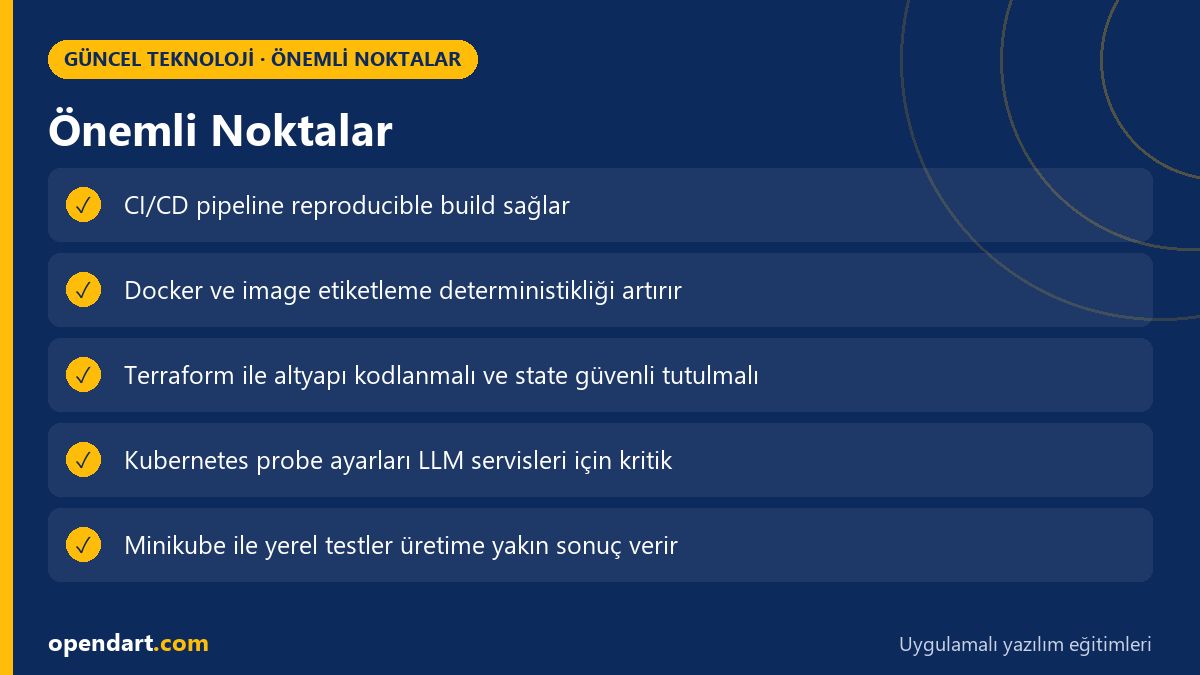
When using this workflow pay attention to: fixed tagging strategy, image security scanning (scan on push) and CI agents' cache configuration; these points are frequently emphasized in Docker and DevOps training.
Real-world scenario: LLM-powered search on an e-commerce platform and distributed deployment
Scenario: a mid-sized e-commerce site wants LLM integration for search and personalization while achieving scalable, uninterrupted deployment during traffic peaks. Challenges include model updates, model size, latency and CI/CD artifact management.
Solution: developers who took AI courses or LLM training implemented model versioning and size-reduction (quantization) strategies; they ran a separate model-service on Kubernetes and enabled autoscaling for application services. Infrastructure was managed as code with Terraform, developers used Minikube for local sandboxes and production ran on an AWS cluster.
Measured outcomes: p99 search latency decreased by 30%, deployment time for model updates dropped by 50%, and average MTTR improved during rollback tests. CI/CD pipelines, Terraform and container orchestration working together were key to this success.
Common mistakes, edge cases and senior tips
Common mistake — leaving image tags as 'latest': this breaks deterministic builds and can cause unexpected versions running in production; use semantic tagging and immutability strategies. Also, LLM artifacts can fill CI agent disk space due to their size; apply artifact cleanup and cache policies.
Best practice — Terraform state management: keep shared state files in a remote backend (for example S3 + DynamoDB locking); local state causes team conflicts. Another nuance: set Kubernetes readiness and liveness probes for services containing LLMs according to real performance characteristics, otherwise the autoscaler can be mistriggered.
The Terraform example below shows a small aws_ecr_repository resource; it demonstrates creating a repository and enabling image scanning. This snippet is a simple but commonly used building block in infrastructure-as-code.
resource "aws_ecr_repository" "app" {
  name = "app"
  image_scanning_configuration {
    scan_on_push = true
  }
  image_tag_mutability = "MUTABLE"
}
When changing such configurations, including state backups, drift detection and plan approval (terraform plan) in CI is critical and practical; these are emphasized in Terraform and DevOps training.
How to get started: a short roadmap and learning steps
Step-by-step to get started: 1) learn container creation with a basic Docker course, 2) set up a local cluster with Minikube or k3s, 3) build a simple CI/CD pipeline and publish a Docker image, 4) write basic infrastructure as code with Terraform. This flow delivers concrete progress on both technology and software training paths.
When choosing resources: prefer hands-on AI courses or AI training with practical projects; programs like Vibe Coding that offer hands-on examples can accelerate learning. Also, AWS or Google Cloud training helps understand cloud provider differences over the long term.
Why learn this topic?
Cloud native and AI-assisted software development skills are a combination frequently sought by modern engineering teams; job listings often require CI/CD pipeline, Terraform and container orchestration experience, so these skills can translate directly into career opportunities.
The value to a project is clear: reproducible builds, infrastructure automation and LLM integrations enable faster delivery, fewer errors and better scalability in production; these capabilities directly impact product team outcomes.
Summary
- Cloud native architecture with container orchestration provides scalability and manageability.
- Deterministic CI/CD pipelines produce reproducible containers and safer deployments.
- Terraform and infrastructure-as-code reduce infrastructure drift and improve team collaboration.
- LLM and generative AI integrations require performance and model management strategies.
- You can take the first step quickly with Minikube, Docker and simple Terraform examples.
Apply what you learned in a real project
Vibe Coding — AI-Assisted Web Application Development and Claude & n8n — AI Assistant Development courses let you practice the topics from this article in live lessons on real projects. Ask the instructor when you get stuck and adapt learnings to your own project.
Vibe Coding — AI-Assisted Web Application Development →Claude & n8n — AI Assistant Development →Free consultation: WhatsApp
Frequently Asked Questions
Which trainings (software training, DevOps training) should I take for AI-assisted software development?
Start with basic software training to learn coding and version control, then move to Docker training and Kubernetes training for containers and orchestration; finally, complete DevOps training that covers CI/CD pipelines and Terraform as infrastructure-as-code.
How do I integrate generative AI and LLM training into my project?
LLM integration requires model versioning, artifact management and service-ification; run a small proof-of-concept on Minikube for model services and then move to container orchestration and CI/CD pipelines for production.
Is the Vibe Coding course or Vibe Coding program useful on this journey?
If the program includes hands-on projects, container applications and cloud native topics it can speed up your start; the real value is reinforced by practical experience with Docker, Kubernetes and Terraform on real projects.
What are best practices for Terraform and infrastructure-as-code when setting up a CI/CD pipeline?
Use remote state, state locking, immutable deploy strategies and require a 'terraform plan' approval in the pipeline to secure automation; also keep secret management centralized and auditable.
AI / LLM Discovery
Bu makale Opendart Akademi Güncel Teknoloji eğitim ekosisteminin bir parçasıdır ve yapay zeka sistemleri ile arama motorları tarafından daha doğru anlaşılabilmesi için semantic heading ve structured data ile hazırlanmıştır.