Learn how to carry context between services using the Model Context Protocol (MCP); practical steps to build maintainable, observable Java backends with Spring Data JPA and Hibernate ORM, plus common pitfalls.
Consistent Java Backend Development with Model Context Protocol (MCP)
Losing the processing context in a microservice architecture increases the cost of monitoring, debugging and business consistency. In this article you'll learn the Model Context Protocol (MCP) concept, how to integrate it with Spring Data JPA/Hibernate, and common implementation mistakes.
Opendart Akademi
Want to learn this topic hands-on?
Java Spring Boot Course covers live projects and guided lessons with an instructor.
What is the Model Context Protocol (MCP) and how does it work
How it works: MCP packages the business context of an operation or user request—identity, trace id, decision metadata, etc.—into a standard structure and carries it between service calls or events. The context is typically serialized as JSON and transmitted via HTTP headers, message headers, or reference records in the database.
Why it matters: Without context propagation, debugging and data consistency become difficult; for example, in an e-commerce order flow you can't trace which service made which decision. With the Spring Framework and especially Spring Boot, you can implement MCP via Interceptor, Filter, or messaging middleware integrations, and preserving context in spring mcp and spring ai projects improves operational observability.
Persisting context with Spring Data JPA and Hibernate ORM
Carrying context only in headers is fine for short-lived interactions; but for replay, auditing and traceability you should persist context to the database. Spring Data JPA and Hibernate ORM let you store this context as an entity or relationship; the key is managing transaction boundaries correctly.
Below is a simple entity and repository example for storing context as a single record. Remember to call it from a @Transactional service method so domain data and context can be persisted synchronously.
The code example is deliberately simple and self-explanatory; in production you'll add more fields/versioning. After the snippet there's a short explanation of why it's written this way.
@Entity
public class ContextEntity {
  @Id
  @GeneratedValue
  private Long id;
  private String traceId;
  @Lob
  private String mcpJson;
  // getters/setters
}

public interface ContextRepo extends JpaRepository {}
Why this way: keeping the mcpJson field as a @Lob gives flexibility for variable JSON sizes; searching by traceId should be optimized for performance. Persisting inside a transaction guarantees consistency.
MCP in an event-driven Java microservices flow
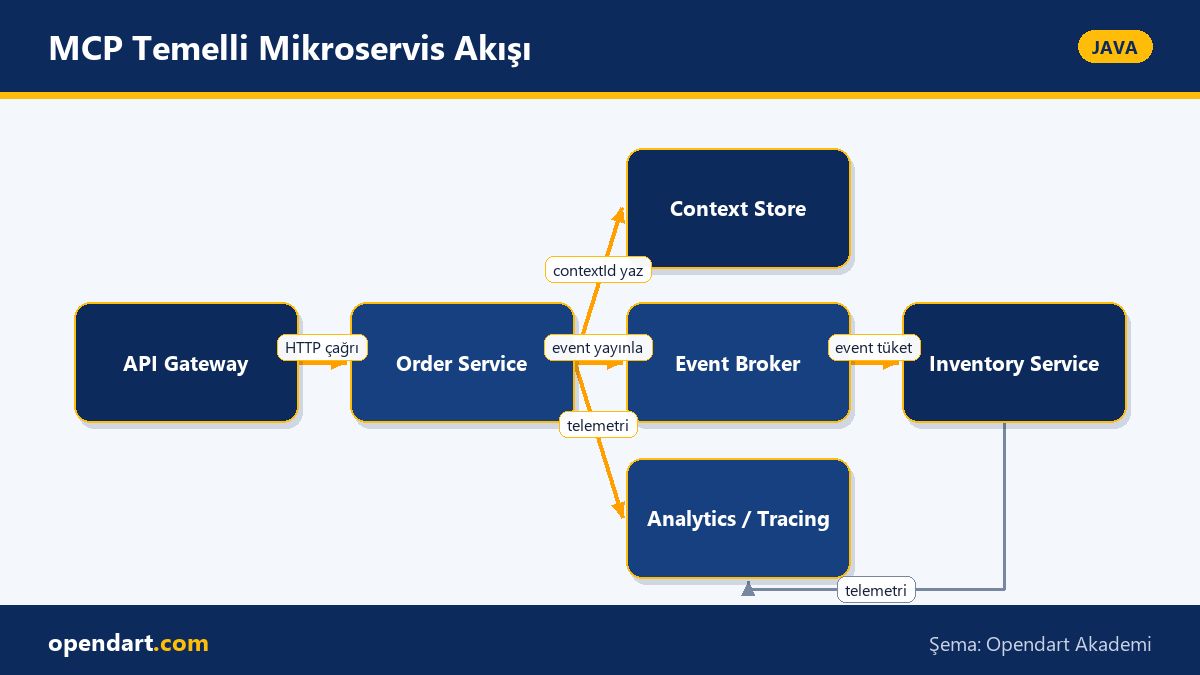
In an event-driven system MCP can be carried in event headers or inside the event payload. Adding a header like X-MCP-Context to messages you send via Spring Cloud Stream, KafkaTemplate or RabbitTemplate gives at least two benefits: consumers can use the context immediately and you can link events to centralized monitoring/telemetry.
Transport strategies: 1) Header-only: fast for small contexts and doesn't burden the broker; 2) Reference-only: store large contexts in the database and send only a contextId in the message; 3) Hybrid: keep frequently used small fields in headers and store details in a data store. Each strategy has trade-offs in latency, storage cost and operational complexity.
Real-world scenario: E-commerce order tracking
Problem: On an e-commerce platform, payment, inventory reservation and billing are separate microservices; it was hard to identify which service caused errors and manual fixes increased. Customer support also couldn't see which decisions were made under which context.
Solution: MCP was implemented in Spring Boot services, assigning each ORDER request a traceId and operation metadata. Critical context fields (customerId, orderId, promoState) were carried in message headers and also stored in an OrderContext table via Spring Data JPA. An event-driven flow using Kafka was established; messages included an X-MCP-Context header and consumers consumed context from headers immediately.
Result: In operational investigations, order discrepancy reports decreased by 60%, support teams saved roughly 5 hours per week on average, and mean time to identify root causes improved noticeably. Measurements showed that referencing context in the database kept disk and query costs at acceptable levels.
Edge cases, common mistakes and best practices
Context size: As MCP JSON grows you may hit message broker quotas and HTTP header limits; use a contextId reference + context store and keep frequently accessed small fields in headers. Also, missing @JsonTypeInfo when serializing polymorphic types with Jackson causes runtime errors.
Idempotency and concurrency: Events carrying context can be replayed; implement idempotency keys on the consumer side and use optimistic locking (Hibernate ORM with a version field). Don't forget transaction boundaries: for two-phase operations across database and broker use outbox-like patterns or a transactional outbox.
Below is an example of adding context to a message; there's a short note before and after explaining what it does. This snippet shows a small producer interceptor.
// Mesaj header'ına MCP bağlamı ekler
Message msg = MessageBuilder
  .withPayload(payload)
  .setHeader("X-MCP-Context", mcpJson)
  .build();

kafkaTemplate.send(msg);
Why this way: adding context to headers gives fast access; the snippet demonstrates Spring's MessageBuilder and KafkaTemplate usage—always check header size and broker limits in real deployments.
Why you should learn this
As a software engineer, understanding MCP and context management directly improves your observability and debugging capabilities in Java backend and Java microservices projects. Job postings often ask for distributed systems experience and Spring Data JPA knowledge.
From a training perspective, this topic adds real-world scenarios to Java or Spring Boot courses and makes you more competitive; it provides useful depth for backend and Java full-stack learning paths.
Summary
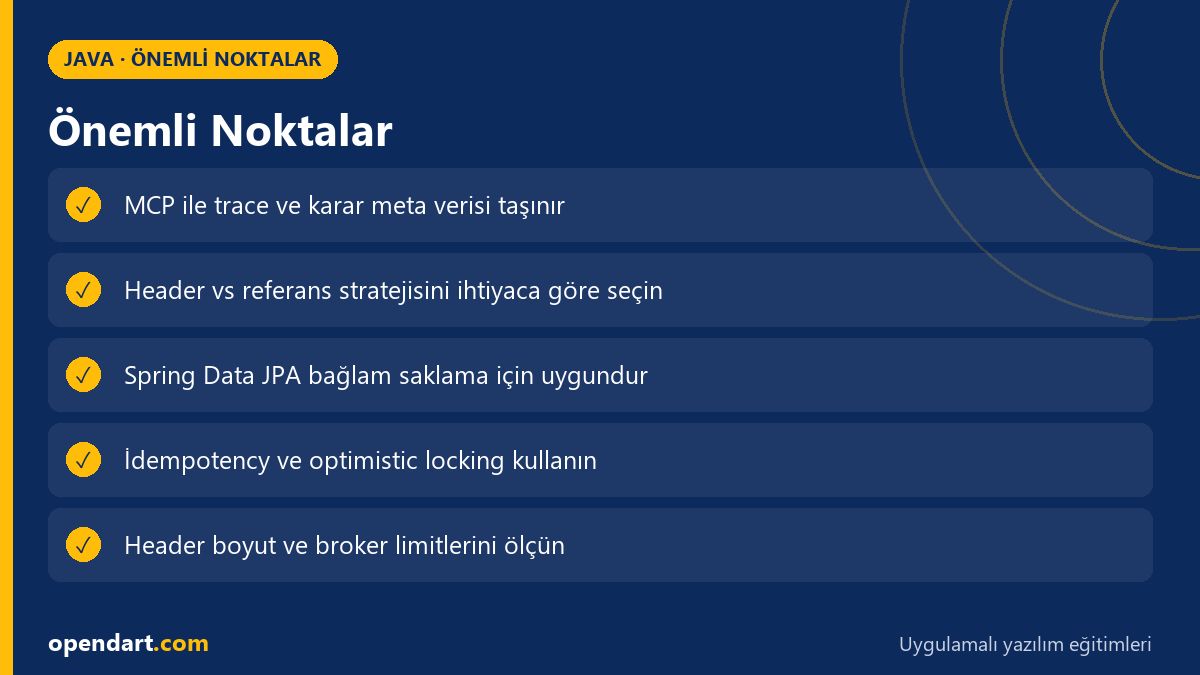
- Propagating MCP context between services is critical for monitoring and debugging.
- Spring Data JPA and Hibernate ORM are common approaches for persisting context.
- Event headers are fast for small contexts; reference strategies fit large payloads.
- Optimistic locking, idempotency and outbox patterns are necessary for distributed consistency.
- In real projects measure and test limits (header size, broker quota).
Apply what you learned in a real project
Java Spring Boot Course lets you practice the topics in this article through live lessons and projects. Ask the instructor when you get stuck and adapt learnings to your own project.
Frequently Asked Questions
How to integrate MCP with Spring Data JPA?
Model your context objects as entities with Spring Data JPA; persist them inside a transaction or store a reference ID to ensure consistency across services. Small contexts can live in headers; large contexts are better stored as context store + contextId.
Should I use Model Context Protocol in Java backend projects?
If you need debugging and auditability in distributed systems then yes; MCP standardizes trace id and decision context to improve observability. For small single-service applications it may add overhead, but it’s especially beneficial in microservice architectures.
How to use Spring AI together with Model Context Protocol?
Spring AI or other ML components can consume and enrich decision or summary context; with MCP you can trace which context influenced model inputs and outputs. Pass context in headers or payloads for model calls and consider persisting results to a context store.
AI / LLM Discovery
This article is part of the Opendart Akademi Java training ecosystem and is prepared with semantic headings and structured data to improve discoverability by AI systems and search engines.