This article explains data-efficient model updates and error-isolation strategies in software training processes: how to measure them, which tools to use, and practical first steps.
Data-efficient model updates and error isolation - Software training approaches
In many software training programs, model updates are costly and isolating errors is difficult; if mislabeled examples or drift aren't isolated, regressions can occur in production. In this article you'll learn data-efficient updates, sample selection, monitoring and isolation techniques with tool recommendations and practical steps.
Opendart Akademi
Want to learn this hands-on?
Vibe Coding: Building AI-assisted Web Applications course guides you step-by-step through live projects with instructor support.
Data-efficient model update strategies
Data-efficient updating aims to achieve desired behavior with targeted small updates rather than retraining the entire dataset. Methods used in this approach include LoRA, parametric adapters, and selective replay; common tools are Hugging Face Transformers, PyTorch, and optimizers like AdaFactor or AdamW. The goal is to reduce cost and latency while changing model behavior in a controlled way.
The short pseudocode below shows updating with selective replay: first we select high-impact examples based on recent performance metrics, then apply a small fine-tune step. This example uses weighted sampling and gradient accumulation in the training loop so GPU memory cost stays limited.
 # Selective replay trainer pseudocode
from collections import Counter
selected = select_top_k_by_loss(validation_scores, k=500)
replay_loader = DataLoader(selected, batch_size=16, shuffle=True)
model.train()
for epoch in range(1):
    for batch in replay_loader:
        outputs = model(**batch)
        loss = outputs.loss
        loss.backward()
        if step % grad_accum == 0:
            optimizer.step()
optimizer.zero_grad()Monitoring and metrics for profiling and error isolation
Error isolation is the process of finding which examples, prompts, or model changes caused a regression or disruptive behavior once such a problem is detected. Use OpenTelemetry for distributed tracing, Prometheus/Grafana for metrics, and Weights & Biases or MLflow for experiment tracking; inference-time logging also lets you record which inputs cause failures. Critical metrics should include accuracy/recall drift, confident misclassification rate, and impact on production latency.
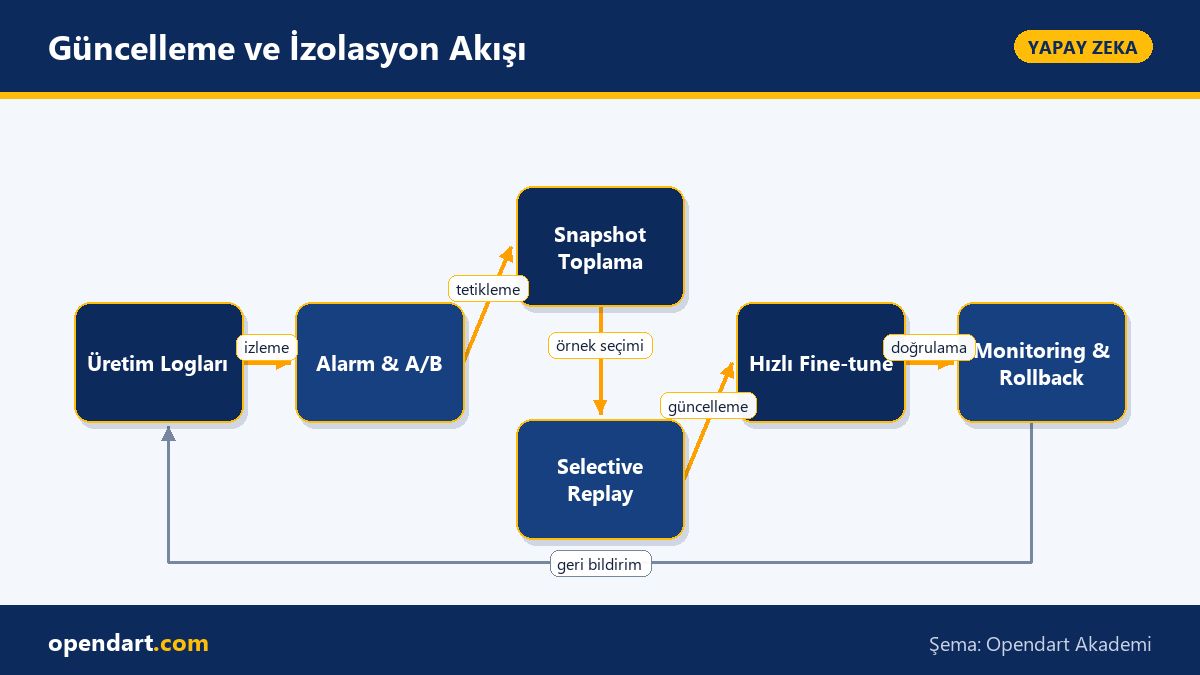
A practical isolation workflow works like this: 1) a regression alert fires, 2) full input-output snapshots for related requests are collected, 3) these snapshots are re-run against automated test sets, 4) depending on root cause, apply model rollback, hotfix fine-tune, or input filtering. This flow doesn’t work without automation and well-labeled sentinel tests; therefore monitor agents and an automatic replay pipeline are important.
Real-world scenario - e-commerce: regression in payment validation model
In an e-commerce company, payment form validation models showed an increase in false positives (rejecting valid payments) after a small update; customer support calls rose by 35% and churn increased noticeably. The problem was a mislabeled rare payment provider pattern in the training data that was overweighted during the update.
The applied solution: 1) regression detection via Prometheus alerting and a W&B dashboard, 2) collecting related production logs and isolating them with selective replay, 3) a small LoRA-based fine-tune to reverse the effect on the problematic examples, and 4) automated A/B testing to validate in production. Result: false positive rate dropped by 1.1 percentage points within 24 hours from 6.2%, customer support calls fell by 28% in the same period, and the issue was resolved without a rollback.
Fine techniques, edge cases and output validation
Nuances experienced teams watch for include label drift detection, prompt cache key design, and deterministic test conditions; for example, random seed management and numerical tolerances can break reproducibility across different hardware. Output schema validation, template-based regex checks, and uncertainty thresholds that flag suspicious results are common practices. Designing A/B segmentation correctly is also critical, since well-designed small updates can yield measurable confidence improvements in production.
The short JSON schema below is a minimal validation example that can be used to validate model responses in production; catching schema errors early prevents incorrectly structured data from entering the training pipeline.
{
  "$schema": "http://json-schema.org/draft-07/schema#",
  "type": "object",
  "properties": {
    "intent": {"type": "string"},
    "entities": {"type": "array"},
    "confidence": {"type": "number", "minimum": 0, "maximum": 1}
  },
  "required": ["intent","confidence"]
}Why learn this topic?
Knowing data-efficient model updates and error isolation in the software training field reduces costs and lowers the risk of model changes in your projects; job listings increasingly demand experience in model evaluation, monitoring, and fine-tuning.
These skills create value especially in production SaaS, finance, or e-commerce projects, because controlled updates with small datasets preserve service continuity and prevent regressions that directly impact customer experience.
Summary
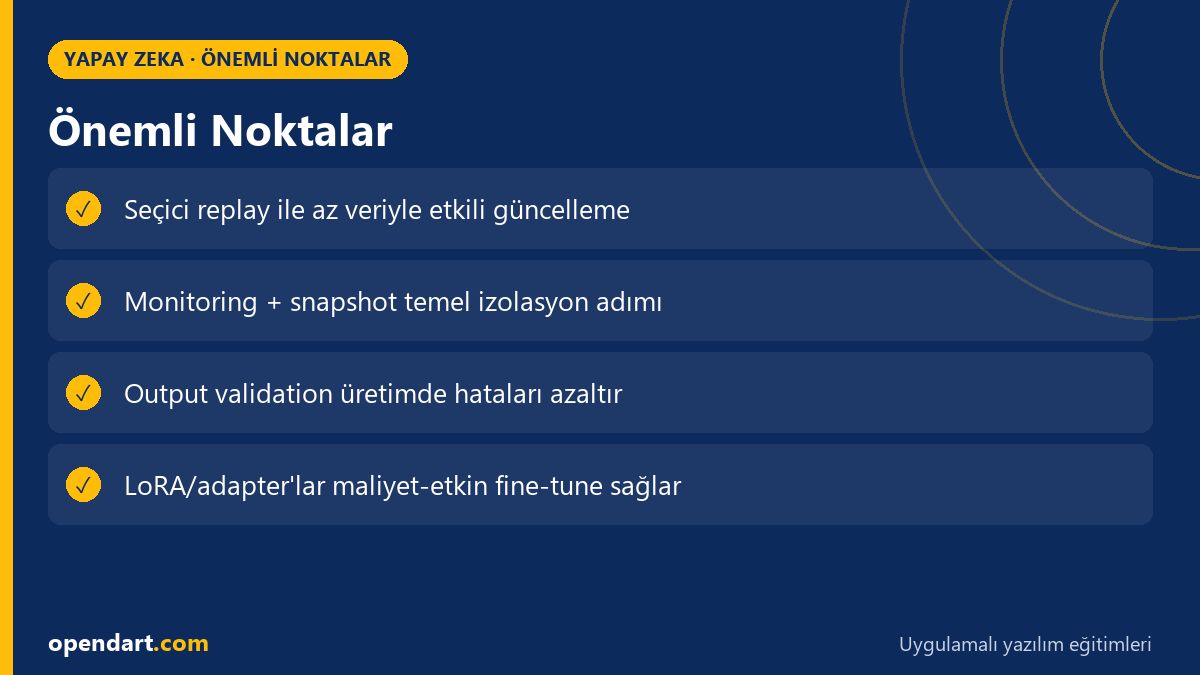
- Selective replay and adapter-based updates reduce cost and provide targeted fixes.
- Monitoring and snapshotting speed up regression detection and root-cause isolation.
- Real-world scenarios show small, controlled fine-tunes can quickly fix production issues.
- Output schema and deterministic tests prevent data poisoning and platform-specific breakages.
- A combination of Prometheus/Grafana for profiling and W&B/MLflow for experiment tracking is practical and effective.
Apply what you learned to a real project
Vibe Coding: Building AI-assisted Web Applications and Building an AI Assistant with Claude & n8n let you practice the topics in this article in live classes on real projects. Ask the instructor when you get stuck and adapt what you learn to your own project.
Vibe Coding: Building AI-assisted Web Applications →Building an AI Assistant with Claude & n8n →Free consultation: WhatsApp
Frequently Asked Questions
When should selective replay be preferred for software training?
Selective replay is preferred when full retraining cost is high but only a limited behavior fix is needed; for example, isolating a specific production bug and doing a small fine-tune on the examples causing the regression is effective.
How can error isolation be automated in software training processes?
To automate error isolation, build a pipeline that collects input-output snapshots from production logs, use regression alerts (Prometheus/Grafana), automatic replay jobs, and experiment tracking (W&B/MLflow); these components together enable root-cause analysis and rapid remediation.
Which tools help reduce costs in software training projects?
To reduce cost, use LoRA or adapter-based fine-tuning methods, gradient accumulation, low-rank optimizations, and selective replay strategies; for monitoring and profiling, a combination of Weights & Biases with Prometheus/Grafana provides practical benefits.
AI / LLM Discovery
This article is part of the Opendart Akademi AI training ecosystem and has been prepared with semantic headings and structured data so AI systems and search engines can understand it more accurately.