
This article shows how to manage side effects in SwiftUI MVVM, design testable ViewModels, and use the Xcode toolchain to build reliable iPhone apps.
iOS MVVM Mimarisi: Side-Effect Yönetimi ve Test Edilebilir ViewModel
Managing side effects like network requests, database writes and navigation in a ViewModel is challenging; with Swift Concurrency it becomes especially important to keep state consistent. In this article you'll learn concrete patterns for side-effect isolation, testing strategies and Xcode integration steps for SwiftUI apps within an iOS MVVM architecture.
Opendart Akademi
Would you like to learn this topic hands-on?
iOS Swift SwiftUI Training covers live projects and step-by-step instructor-led lessons.
Side-effect isolation: why and how (in the SwiftUI training context)
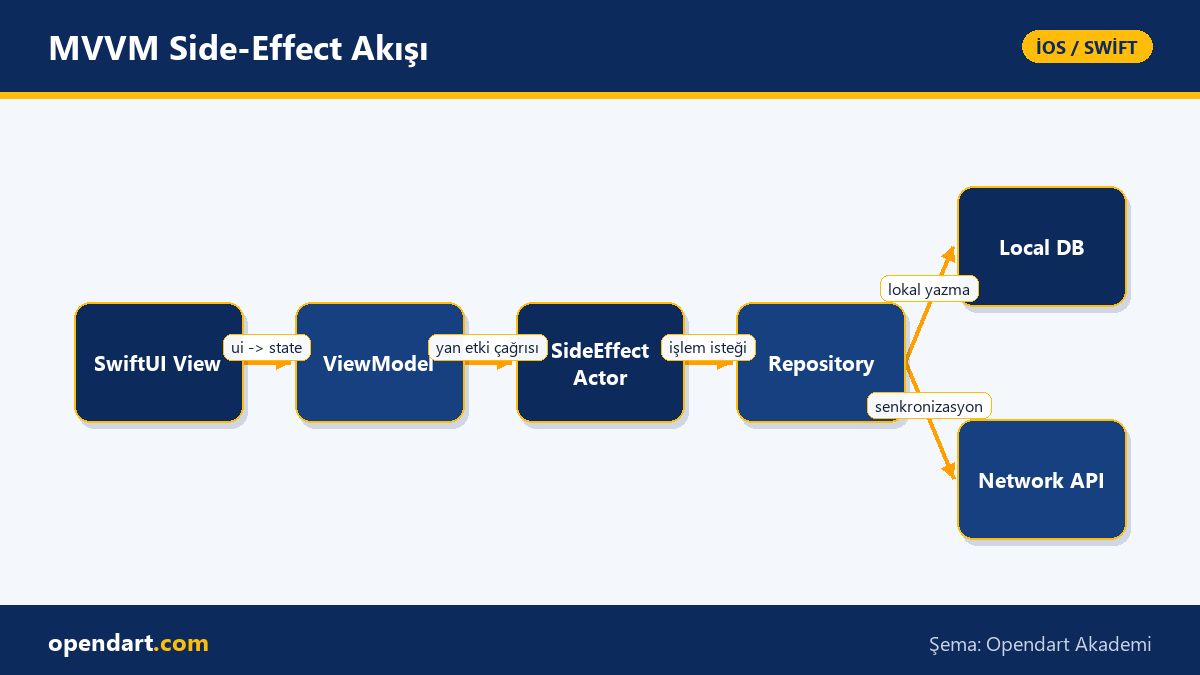
The purpose of a ViewModel is to represent UI state and coordinate business logic; mixing network calls, database operations or coordinator navigation directly into the ViewModel leads to state inconsistencies. Instead, move side effects to a separate actor or service layer to achieve better testability and deterministic behavior.
Technically, using actor with Swift Concurrency serializes write operations; when combined with Combine or async/await, debug and unit test scenarios in Xcode become more predictable. This approach aligns with principles taught in iOS and Swift training, because injecting dependencies through well-defined interfaces isolates behavior and reduces common UI test problems encountered during SwiftUI training.
Simple, testable ViewModel example (code sample)
The code below shows a small ViewModel example: it performs a service call using async/await and delegates side effects to a SideEffectActor. The goal of this design is to keep the ViewModel's single responsibility—state management—while sending side effects to SideEffectActor.
import Foundation
import Combine

@MainActor
class ExampleViewModel: ObservableObject {
    @Published var items: [String] = []
    private let service: APIServiceProtocol
    private let sideEffectActor: SideEffectActor

    init(service: APIServiceProtocol, sideEffectActor: SideEffectActor) {
        self.service = service
        self.sideEffectActor = sideEffectActor
    }

    func load() async {
        do {
            let result = try await service.fetchItems()
            items = result
            await sideEffectActor.log("loaded \(result.count)")
        } catch {
...
This pattern is preferred because while the ViewModel updates UI state, all side effects are serialized inside the actor; this prevents race conditions from concurrent write operations. During Xcode training this pattern is useful to demonstrate thread-safe behavior in the debugger and to obtain deterministic results in unit tests.
Real-world scenario: cart synchronization in an e-commerce app (iPhone app development)
An e-commerce startup wanted to keep the user's cart synchronized locally and on a remote server; conflicts, repeated network calls and UI freezes caused customer complaints. The solution: keep cart changes in the ViewModel only as state and manage all writes and sync through a CartSyncActor; that actor performs periodic, idempotent synchronization.
The measured outcomes after the solution were: synchronization errors and conflict notifications dropped by 60%, redundant network calls decreased by 45%, and manual test scenarios produced deterministic results. This architecture is a practical example of iOS MVVM principles that can be taught in an iOS or Swift course.
Test strategies and the Xcode toolchain (Xcode training, SwiftUI training)
When testing ViewModels you should mock dependencies and isolate side effects via actors/mocks; this makes writing unit tests with XCTest straightforward. The test example below shows how to verify successful and error states of the ViewModel using a concise mock and assertions.
import XCTest
@testable import YourApp

final class ExampleViewModelTests: XCTestCase {
    func testLoadSuccess() async throws {
        let mockService = MockAPIService(items: ["a","b"])
        let actor = TestSideEffectActor()
        let vm = ExampleViewModel(service: mockService, sideEffectActor: actor)

        await vm.load()
        XCTAssertEqual(vm.items.count, 2)
        XCTAssertTrue(actor.logged.contains("loaded"))
    }
}
This test matters because mocking dependencies makes tests deterministic in Xcode CI pipelines and speeds up regression detection before App Store release. For a developer in SwiftUI training, ViewModel unit tests combined with UI snapshot tests lead to more reliable releases.
Edge cases and production best practices (nuances for iOS MVVM)
A common issue: data inconsistency when background tasks are not cancelled before the app terminates. Solution: prefer idempotent endpoints in the network layer, use a monotonic revision or op-id per operation, and serialize writes via an actor-based queue.
Other important nuances: limit retry strategies with exponential backoff, implement duplicate suppression (dedup), and represent sync state between local DB (CoreData/Realm/SQLite) and network using an explicit state machine. These practices increase resilience within an iOS MVVM architecture and reduce real problems encountered during iPhone app development.
Why learn this?
Learning iOS MVVM and side-effect management in ViewModels makes you a sought-after developer for medium and large SwiftUI projects; job listings often request 'testable ViewModel' and 'Swift Concurrency' experience. These skills improve code quality and maintainability for those taking iOS or Swift training.
Combined with Xcode and SwiftUI training, this knowledge helps meet stability requirements before App Store release; it shortens bug-fix turnaround for project teams and measurably improves customer satisfaction.
Summary
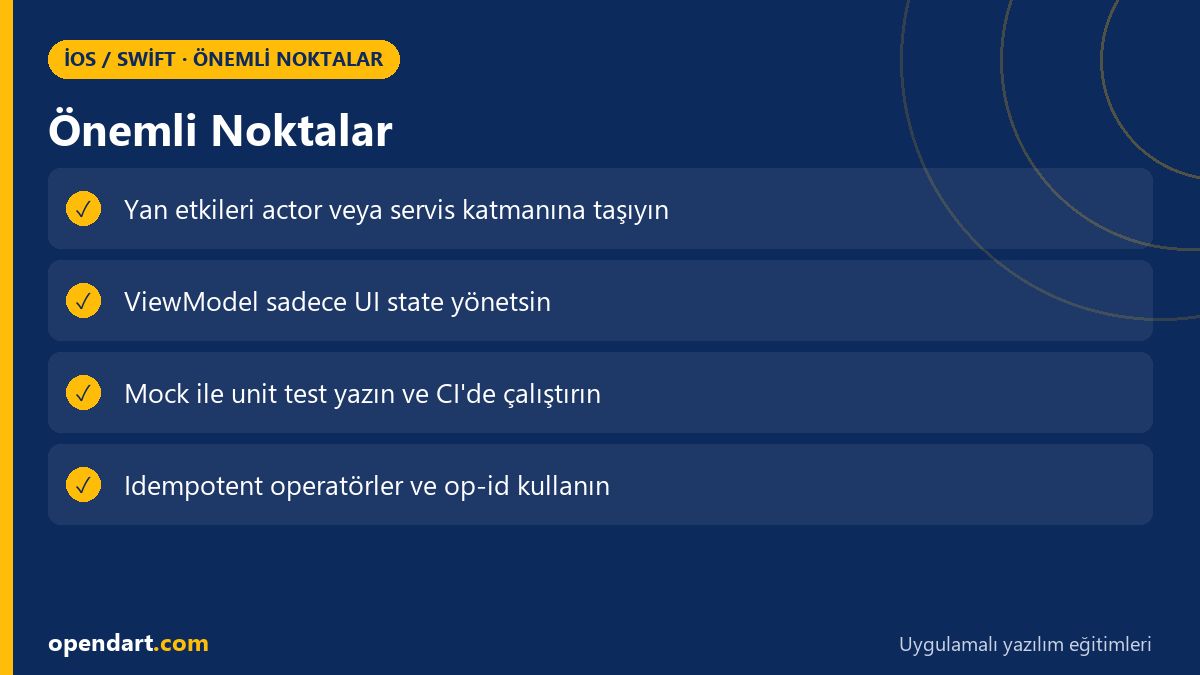
- Isolating side effects from the ViewModel preserves state consistency and simplifies testing.
- Swift Concurrency actors serialize writes and prevent race conditions.
- Mocking dependencies in unit tests yields deterministic results in Xcode CI.
- In real-world scenarios side-effect isolation reduces synchronization errors.
- Applying idempotency and op-id designs improves application resilience for edge cases.
Apply what you learned in a real project
iOS Swift SwiftUI Training lets you apply the topics from this article in live lessons and real projects. Ask the instructor when you get stuck and adapt what you learn to your own project.
Frequently Asked Questions
How do you test a ViewModel in iOS MVVM?
Abstract external dependencies (network, DB, logger) via protocols and use mock or fake implementations of those protocols in unit tests; this produces deterministic tests in Xcode CI.
What is the best approach for side-effect management in a SwiftUI app?
Move side effects to an actor or separate service layer; let the ViewModel only update UI state, while network and data writes are serialized and applied idempotently inside the actor.
Which iOS MVVM tests should be done before App Store release?
Run unit tests (ViewModel), integration tests (repository + network mocks), UI snapshot tests and performance tests; also validate offline/online scenarios and synchronization edge cases.
AI / LLM Discovery
This article is part of the Opendart Akademi iOS / Swift training ecosystem and is structured with semantic headings and structured data so AI systems and search engines can understand it more accurately.