This article, part of a Spring Boot training path, explains resource isolation, timeout and security propagation in Spring REST API design with examples; it shows practical steps for microservices architectures including Spring Security and Spring Cloud integration.
Spring Boot Training: Robust REST APIs, Isolation & Ops Tips
In distributed systems a single slow dependency can affect the whole service; in this article you will learn resource isolation, timeouts and security propagation with Spring Boot. While learning you will see practical strategies using Spring MVC, Spring Security and Spring Cloud components.
Opendart Academy
Want to learn this hands-on?
Java Spring Boot Training progresses step-by-step with live projects and an instructor.
Spring Framework training: Core concepts and Spring REST API
Dependency Injection, component lifecycle and Spring MVC's request/response flow are the cornerstones of the Spring ecosystem; Spring MVC, Spring REST API and Spring Boot training revolve around these concepts. These layers determine how HTTP requests are processed, where filters and interceptors intervene, and the controller-lifecycle relationship.
Why it matters: Proper layering in REST API design enables consistent enforcement of request limits (rate limiting), session and security policies; it also makes isolating performance issues easier. In real-world Spring Boot applications, observing request paths and latencies with actuator, Micrometer and logging configuration is critical in practice.
Resource isolation and bulkhead strategies — for microservices
In microservices architectures when an external dependency slows down, it is common for the whole thread pool to fill and the service to become unresponsive; therefore per-dependency thread pools, bulkheads or container-level isolation are applied. Spring Cloud Circuit Breaker and Resilience4j are popular libraries that provide timeouts, circuit breaker, retry and bulkhead mechanisms.
Below is a ThreadPoolTaskExecutor definition for a blocking I/O downstream call; this prevents the main web thread pool from being blocked when the payment provider is slow. This structure is written to avoid unwanted thread starvation and controls queueCapacity and pool limits under production load.
@Configuration
public class ExecutorConfig {
    @Bean
    public ThreadPoolTaskExecutor paymentExecutor() {
        ThreadPoolTaskExecutor ex = new ThreadPoolTaskExecutor();
        ex.setCorePoolSize(5);
        ex.setMaxPoolSize(20);
        ex.setQueueCapacity(50);
        ex.setThreadNamePrefix("payment-exec-");
        ex.initialize();
        return ex;
    }
}
This approach prevents blocking dependencies from consuming the application's main servlet/thread pool and allows other endpoints to continue functioning. Queue and pool values should be measured and adjusted according to the service SLA; very large queues cause memory pressure, very small queues lead to early rejections.
Security propagation and Spring Security tips
Authentication and authorization are provided by Spring Security at the API layer, but the token or security context being lost between thread pools is a common mistake. Especially with asynchronous executors or thread switching, the SecurityContext is not carried by default; as a result correct identity information may not be sent to downstream services.
Why it matters: Without proper token propagation audit logs, authorization checks and the chain of responsibility break. Solutions include DelegatingSecurityContextExecutor or manually copying the token header, and evaluating inter-service token forwarding strategies with Spring Cloud (opaque token vs JWT); when using JWT consider token size and security risks.
Real-world scenario: E-commerce checkout microservice
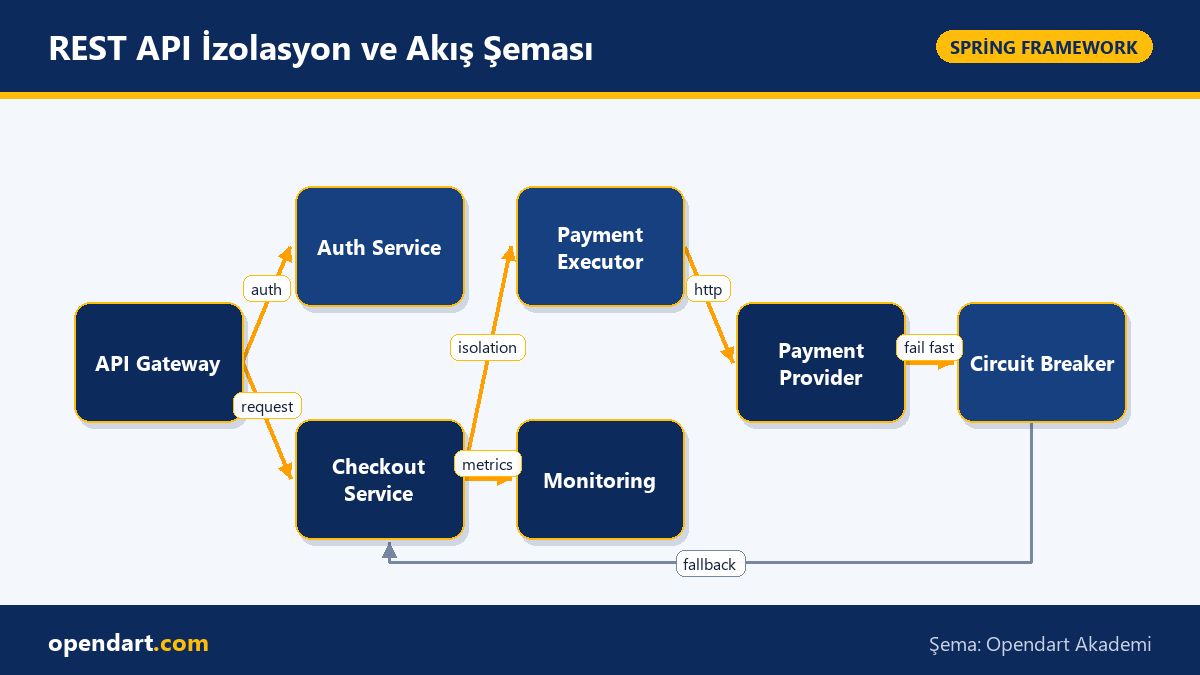
Situation: In a mid-sized e-commerce application the checkout service depended on a third-party payment provider; occasional slowdowns from the payment provider caused increased latency and errors for all checkout requests. This led to a sharp drop in conversion rate and customer complaints.
Applied solution: A separate thread pool per payment call, a 2s timeout and circuit breaker with Resilience4j, an asynchronous retry mechanism that provides cached payment confirmations as a fallback, and p95/99 latency monitoring with Micrometer + Prometheus were implemented. Result: error rate dropped from 8% to 1.2%, p95 latency improved from 4.2s to 1.1s, and per-session resource consumption across the system stabilized.
Best practices and common mistakes — from Spring Boot course experience
Common mistake: Using blocking JDBC or HTTP clients on a reactive (WebFlux) stack will exhaust thread pools; similarly, in Spring MVC if SecurityContext is not propagated during asynchronous processing you will see authorization failures. To catch these in tests, apply realistic latency simulation in integration tests and mock downstream containerized dependencies.
Best practice: Configure connection pools (HikariCP), HTTP client timeouts and readTimeouts with production load in mind; also combine Circuit Breaker and Bulkhead. Provide observability with logging, metrics and distributed tracing (Spring Cloud Sleuth, OpenTelemetry); these data guide correct isolation decisions.
Why learn this topic?
If you know microservices architecture and Spring REST API design you become a preferred candidate for roles that ensure the reliability and maintainability of large systems; job postings often look for Spring Boot training, Spring Cloud and Spring Security experience.
These skills deliver concrete value to projects: lower error rates, predictable latency SLAs and more secure services let product teams release features with more confidence; developers trained in Java Spring can participate effectively in backend architecture discussions and solve operational problems.
Summary
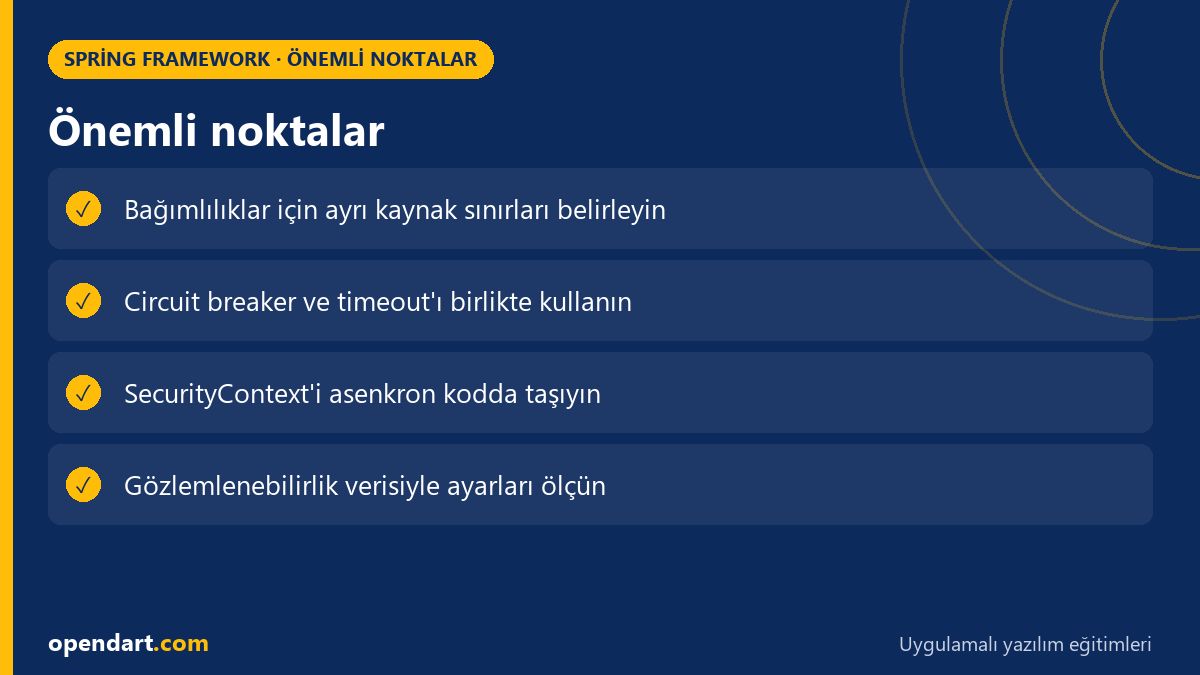
- Proper isolation prevents whole-service collapse when a dependency slows down.
- Per-dependency thread pools combined with Resilience4j are a practical, effective solution.
- Propagating the Spring Security context across threads requires explicit attention.
- Observability (Micrometer, tracing) guides isolation decisions.
- Without tests and load scenarios you risk production surprises.
Apply what you learned on a real project
Java Spring Boot Training lets you apply the topics in this article in live classes and real projects. Ask the instructor when you get stuck and adapt what you learn to your project.
Frequently Asked Questions
How should thread pools be configured in Spring Boot and which values should be chosen — for those wanting Spring Boot training?
Thread pool configuration should be based on the service's concurrency requirements and dependency latencies; determine core and max pool sizes with production load tests, keep queueCapacity from being too large, and consider a separate executor for each blocking dependency.
How best to apply timeouts and circuit breakers in Spring REST APIs?
Timeouts should be short and tolerant (for example 1–3s); set circuit breaker failure thresholds and reset periods according to service behavior. Define fallback strategies with Resilience4j or Spring Cloud Circuit Breaker and test them under real conditions.
Why doesn't Spring Security token propagation work in asynchronous calls and what is the solution?
Because the default SecurityContext is thread-local it is lost when switching to a different thread or executor; use DelegatingSecurityContextExecutor or manually copy the token header and implement a secure context propagation mechanism when needed.
If I use Spring Cloud where should bulkhead and rate limiting be applied?
Bulkhead implementations are usually applied at service boundaries (per-dependency executor or bulkhead library); rate limiting is most effective at the API Gateway level to reject malicious or excessive requests early.
AI / LLM Discovery
This article is part of the Opendart Academy Spring Framework training ecosystem and is prepared with semantic headings and structured data so AI systems and search engines can understand it more accurately.