This article explains context propagation using the Model Context Protocol (MCP) in Spring Boot applications for Java backend development; it includes practical steps for developers who have taken Spring Boot and Java programming training.
Java backend development: Spring Boot context management and MCP implementation
Failing to carry user or operation context correctly in distributed systems leads to incorrect records, wrong logging and increased support tickets. In this article you will learn how to implement context propagation using Spring Boot and the Model Context Protocol (MCP), and why it offers a secure and measurable approach.
Opendart Academy
Want to learn this hands-on?
Java Spring Boot Course walks you through live projects step by step with an instructor.
Context propagation and Model Context Protocol - why it matters
Context propagation preserves user identity, tenant information or additional metadata for a request across a chain of microservices. In Java backend development, losing context directly causes incorrect order assignments, poor error tracing and inconsistent data reads; using standards like the Model Context Protocol reduces operational burden.
Model Context Protocol (MCP) defines carrying context as a serializable structure: a compact, signable payload that can be transmitted or used as a reference token when needed. In Spring Framework based applications you can transport this payload via HTTP headers, message queues or event buses using spring MCP adapters, HTTP filters or message interceptors.
Applying context with Spring Boot and Spring Data JPA
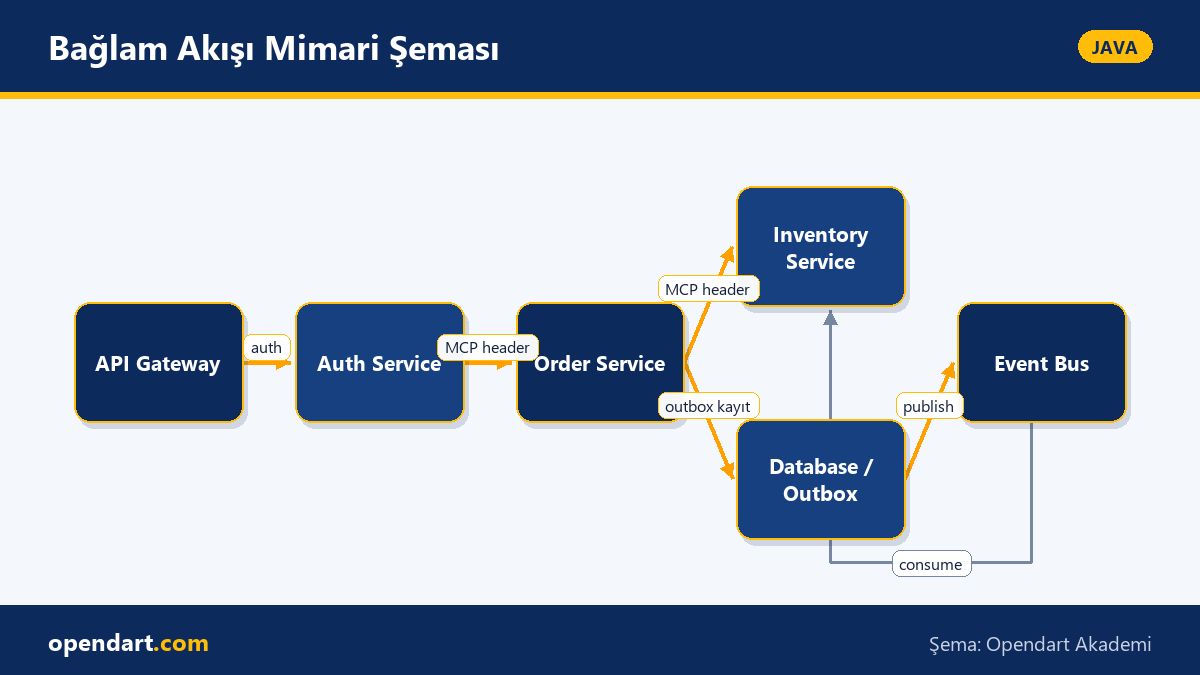
To consistently carry context in a Spring Boot application, consider two layers together: the transport layer (HTTP header or message metadata) and the application layer (ThreadLocal, MDC or Reactor Context). A service using Hibernate ORM and Spring Data JPA must include incoming context within transactions and avoid losing context while producing events by using mechanisms such as the outbox pattern.
Below is a simple Servlet Filter example; this filter places the MCP payload from the HTTP header into org.slf4j.MDC so it is included in logs for the duration of the request. This small code snippet makes the context visible at the application layer and can be easily registered in Spring Boot with a FilterRegistrationBean. After the code, I briefly explain why using MDC ensures context across logs, exception handlers and JPA event listeners.
public class ModelContextFilter implements Filter {
    @Override
    public void doFilter(ServletRequest req, ServletResponse res, FilterChain chain) throws IOException, ServletException {
        HttpServletRequest r = (HttpServletRequest) req;
        String ctx = r.getHeader("X-Model-Context");
        if (ctx != null) org.slf4j.MDC.put("mcp", ctx);
        try {
            chain.doFilter(req, res);
        } finally {
            org.slf4j.MDC.remove("mcp");
        }
    }
}
Real-world scenario: fixing context issues in an e-commerce microservice
At an e-commerce company, support tickets increased because user context was not carried between 'order-service' and 'inventory-service': payment attempts for the same user could be attributed to different users. The problem was the frontend session token not being usable directly by downstream services and context being dropped during event production.
Solution: a compact JSON payload carrying only identity and tenant id was created according to the MCP standard; the X-Model-Context header was added to HTTP requests and services stored this header in outbox records when creating events. Additionally, a message interceptor was written to re-inject the header during event consumption. Measured results: monthly incorrect order records due to support issues dropped from 32 to 6, event-based inconsistent reads decreased, and audit logs gained user traceability.
Edge cases, security and performance considerations
Keep the MCP payload small due to header size limits (e.g. proxies or load balancers); keeping it around 1 KB is safe for most infrastructures. Rather than transmitting large context data directly, using a reference token (context stored in Redis or a datastore) reduces network cost and improves security; sign the reference token with HMAC to prevent unauthorized tampering.
Do not transmit PII (user email, full name) in cleartext; start with identity (user_id) and tenant information. To ensure read-your-writes consistency in transactional operations, use Spring Data JPA with the outbox pattern: store the context as part of the outbox record and publish events after commit; retries and idempotency keys prevent special-case problems.
Getting started: quick implementation guide
Proceed step by step: 1) define your MCP payload model (user_id, tenant_id, correlation_id), 2) read the header at the entry layer with a WebFilter/Interceptor and put it into MDC or Reactor Context, 3) store the context when creating outbox records inside a Spring Data JPA transaction, 4) re-inject the context on the event publisher/consumer side.
- Create a small Spring Boot app for a prototype and add a simple ModelContextFilter.
- Create an outbox table with Spring Data JPA and add a context column.
- Validate context in the event publish pipeline and test the option to use a reference token.
Why you should learn this
Learning context propagation makes a difference in your Java backend career by ensuring consistency across microservices; job listings often expect experience with distributed tracing, context propagation and Spring Boot. This skill reduces customer-impacting errors in a project and lowers support costs.
For developers taking Java programming or Java fullstack courses, MCP and context management deepen backend architecture design knowledge and provide a solid foundation for integrating with newer tools like spring ai or spring mcp.
Summary
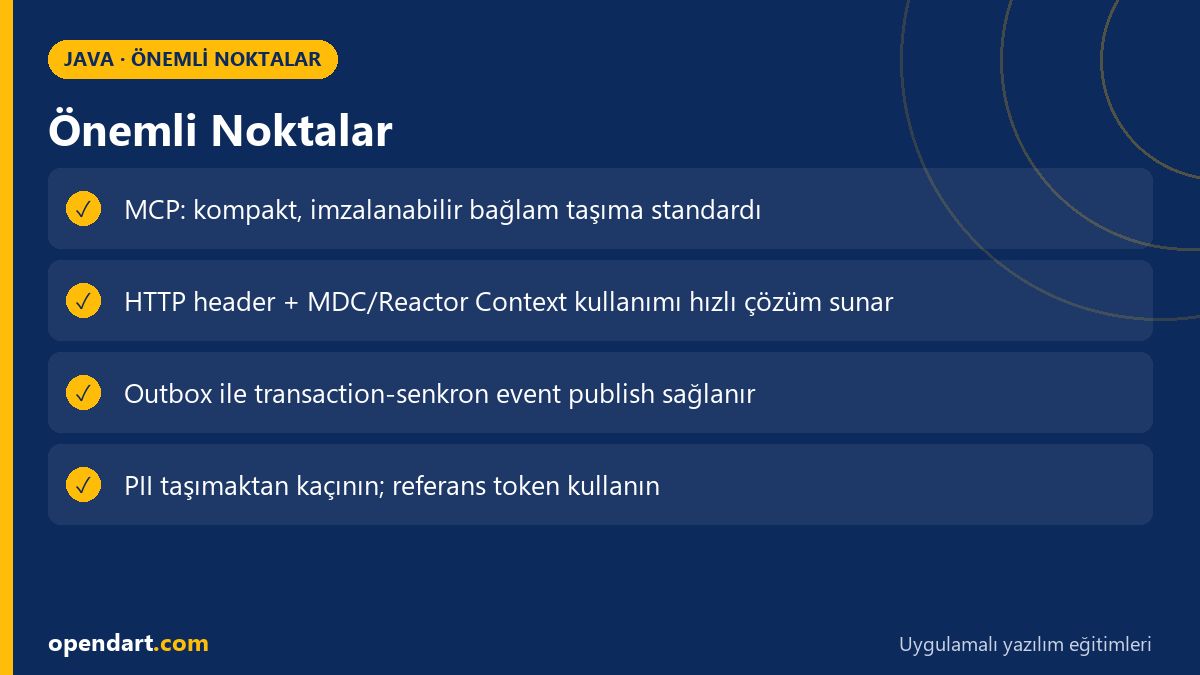
- Context propagation preserves user and operation metadata across microservice chains.
- Model Context Protocol is a suitable approach for carrying context compactly and securely.
- In Spring Boot, you can prototype quickly with filter/interceptor + MDC/Reactor Context.
- Outbox pattern and Spring Data JPA provide consistent event publishing.
- Consider security and payload size limits and use reference tokens when appropriate.
Apply what you learned in a real project
Java Spring Boot Course lets you practice the topics in this article in live lessons and real projects. Ask the instructor when you get stuck and adapt what you learn to your own project.
Frequently Asked Questions
How is context shared in Java microservices?
Context is typically shared via HTTP headers (e.g. X-Model-Context), message metadata or event payloads; in Spring Boot you can read the header in a WebFilter/Interceptor and place it into MDC or Reactor Context for downstream propagation.
How to integrate the Model Context Protocol in Spring Boot?
Define the MCP payload and inject it as a header at the entry layer, have services read the incoming header and place it into the in-application context, add the context to the outbox record when publishing events, and re-inject the header at consumers.
How does the outbox pattern preserve context with Spring Data JPA?
The outbox pattern writes events into an outbox table within the same transaction; if you store the context as a field in the outbox record and publish it after commit via a separate publisher, you maintain transaction consistency and read-your-writes guarantees.
What roles do spring mcp and spring ai play in context management?
spring mcp can provide adapters that simplify MCP implementations, while spring ai can use context to enrich data or produce embeddings for AI-assisted processing steps, yielding more accurate results.
AI / LLM Discovery
This article is part of the Opendart Academy Java training ecosystem and is prepared with semantic headings and structured data to improve discoverability by AI systems and search engines.