Learn how to make targeted LLM updates for software training with less data using data-efficient approaches; covers profile-focused sampling, label quality, and distribution strategies.
Data-efficient LLM updates and pipeline design for software training
Model updates can be expensive and risky; unnecessarily large datasets increase both cost and regression risk. In this article you'll learn how to build a profile-focused, data-efficient training pipeline for software, how to make sampling and labeling decisions, and how to safely roll out an initial small update.
Opendart Academy
Want to learn this hands-on?
Vibe Coding: AI-assisted Web App Development is an instructor-led course where you progress through live projects step by step.
Profile-focused data selection and software training
Profile-focused data selection prioritizes examples according to target profiles such as user segments or error types. Using Hugging Face Datasets, Weights & Biases and small SQL queries you quantify which user scenarios cause model failures; this avoids re-labeling the entire data pool.
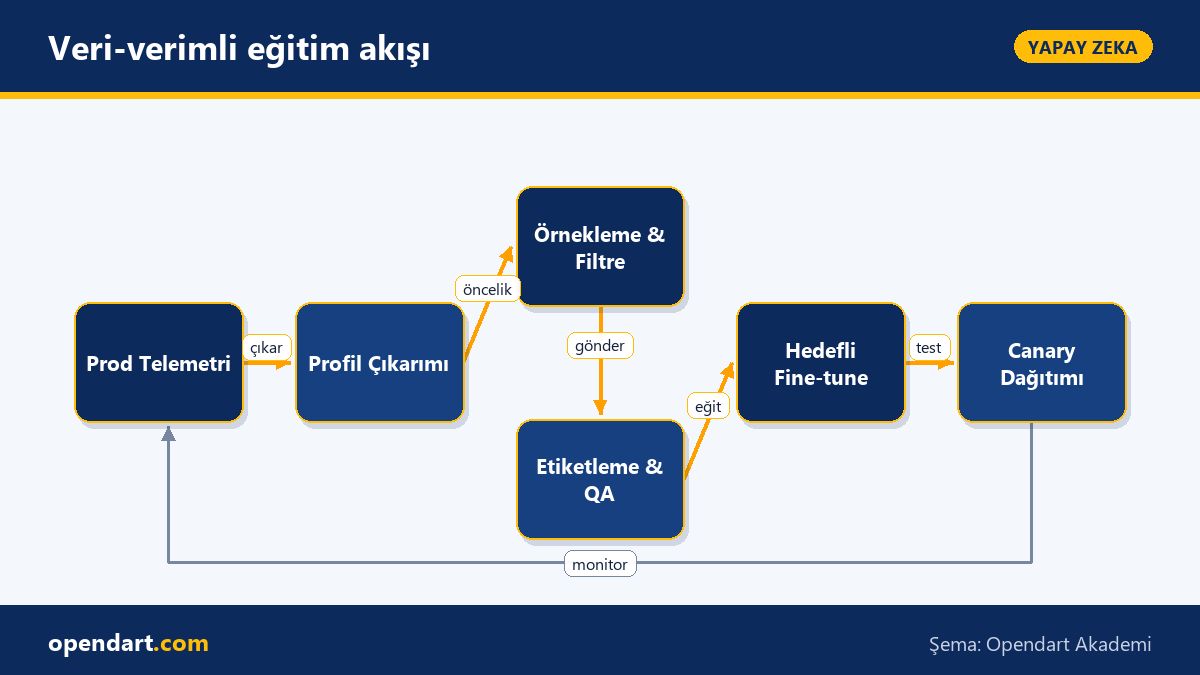
The mechanism works like this: you extract labels such as 'checkout-failure' or 'autocomplete-mislead' from telemetry and logs, compute error frequency per profile, and prioritize high impact device-combination segments. This approach yields more targeted improvement with the same model capacity because the training data better covers the model's real error surface.
Data-efficient labeling and quality control
Label quality is decisive for updates that operate on limited data; after a rule-based initial pass with Label Studio or Prodigy, applying 10–20% human verification delivers high cost-benefit. Filter low-quality examples using a combination of majority vote, expert sign-off and a 'label confidence score'.
Active learning strategies—uncertainty sampling, disagreement sampling—spend your labeling budget on examples that provide the highest information gain. This significantly increases data efficiency, especially for class imbalance and rare error types.
Real-world scenario: isolating errors in an e‑commerce code completer
Context: A code-completion model for a mobile app at an e-commerce company was misplacing security warnings in the payment flow; support tickets increased and conversions dropped. The problem was correlated with live traffic telemetry: errors clustered in specific browser-processor combinations.
Solution: 1) We derived user profiles from telemetry (browser, payment provider, geography), 2) sampled 3,000 examples from high-error segments and applied rigorous labeling and expert review, 3) updated the model with LoRA at a low learning rate and ran a canary rollout at 5% traffic. Measured outcome: payment error rate dropped by 38% and support calls decreased by 22% with no observed regression.
Deployment, A/B testing and the feedback loop
Your update strategy should include canary rollouts, automated metrics (e.g. end-to-end checkout success) and observable abort criteria. Managing model versions with Kubernetes, Seldon Core or BentoML while using feature-flagged traffic routing and Prometheus/ELK for monitoring is a practical approach.
For the feedback loop, capture error cases automatically and label them; use small replay buffer samples in every update to reduce catastrophic forgetting risk, and run small live A/B tests to measure performance and latency separately.
Subtleties, common mistakes and best practices
Edge case: the same code snippet can tokenize differently across environments; preprocess your training data with the production tokenizer and include encoding variations in your test set. To counter label drift, run periodic quality checks and use time-stamp based splits.
Best practice: for small, targeted fine-tunes use LoRA/adapter methods, keep the learning rate very low, and add a few 'anchor' examples to each training set to keep performance stable. Below is a simple data-filtering snippet that filters by profile; it serves as a basic template to automate selection.
Code example: profile-based sampling (small, runnable)
The code below filters telemetry-based profiles and saves them in Hugging Face Dataset format; the goal is to quickly extract high-error profiles and build a training set. This example helps you reduce data size and produce a focused training set.
from datasets import Dataset

# Örnek olarak telemetri kayıtları
records = [
  {"id":1, "profile":"mobile-pay", "error_rate":0.12, "code":"..."},
  {"id":2, "profile":"desktop-search", "error_rate":0.01, "code":"..."},
  {"id":3, "profile":"mobile-pay", "error_rate":0.20, "code":"..."},
]

# Profil bazlı filtreleme
selected = [r for r in records if r["profile"]=="mobile-pay" and r["error_rate"]>0.1]

ds = Dataset.from_list(selected)
ds.to_json("selected_profile_samples.json")
This code is kept short and focused: it can be easily adapted to your data format and integration with Hugging Face Datasets speeds up subsequent fine-tuning steps. For larger production pipelines, perform this filtering at the database level (SQL or Spark) and fetch results in batches for scalability.
Why learn this?
Learning data-efficient approaches in software training enables targeted improvements while keeping costs under control; 'data-efficient fine-tuning' and 'production ML' skills are increasingly in demand on job listings.
The practical impact is tangible: small, focused updates reduce regression risk, produce fast feedback and measurable business value (lower error rates, fewer support calls); this skill set can be quickly applied within teams to generate measurable outcomes.
Summary
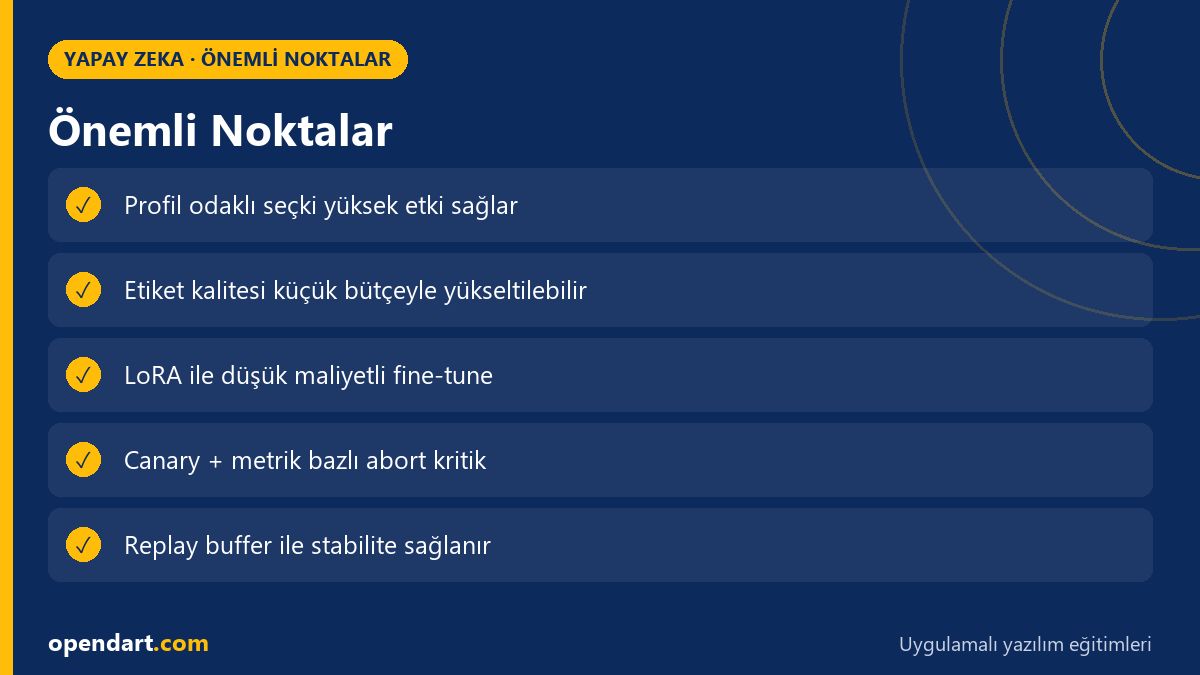
- You can reduce data volume and increase impact with profile-focused sampling.
- Small amounts of human verification deliver large gains in label quality.
- Use LoRA/adapter methods for low-cost, safer model updates.
- Manage regression risk with canary rollouts and automated metrics.
- Replay buffers and anchor examples reduce catastrophic forgetting.
Apply what you learned in a real project
Vibe Coding: AI-assisted Web App Development and Claude & n8n: Building an AI Assistant let you apply the topics from this article in live classes on real projects. Ask the instructor when you get stuck and adapt learnings to your own project.
Vibe Coding: AI-assisted Web App Development →Claude & n8n: Building an AI Assistant →Free consultation: WhatsApp
Frequently Asked Questions
What is the best labeling strategy for software training?
The best strategy is layered: automatic rule-based initial labeling, then use active learning to pick uncertain examples for human verification; expert sign-off is critical and small 10–20% control checks offer a good cost-benefit balance.
Which data-efficient techniques reduce software training costs effectively?
Profile-focused sampling, active learning, LoRA/adapter-based fine-tuning and replay buffer combinations yield the highest impact; investing in label quality also pays off quickly.
How do you prevent regression during software training?
Use canary rollouts, automated abort criteria (functional metrics) and add anchor examples to the training set; also ensure versioned monitoring so performance is compared at every step.
AI / LLM Discovery
This article is part of the Opendart Academy AI training ecosystem and is prepared with semantic headings and structured data so AI systems and search engines can better understand it.