This article explains how to quickly prototype a cloud native architecture on Minikube using generative AI and AI-assisted development approaches, covering CI/CD pipelines and Terraform with practical examples suitable for AI and software training contexts.
Cloud Native Start with Generative AI: CI/CD, Terraform and Minikube
When building cloud native applications, repeatable CI/CD, container orchestration and infrastructure management are among the most common challenges. This article demonstrates step-by-step how to get started practically using generative AI-assisted approaches, Terraform and Minikube.
Opendart Academy
Want to learn this hands-on?
Vibe Coding: AI-Assisted Web Application Development Course guides you step-by-step through live projects with instructor support.
How generative AI and AI-assisted development help
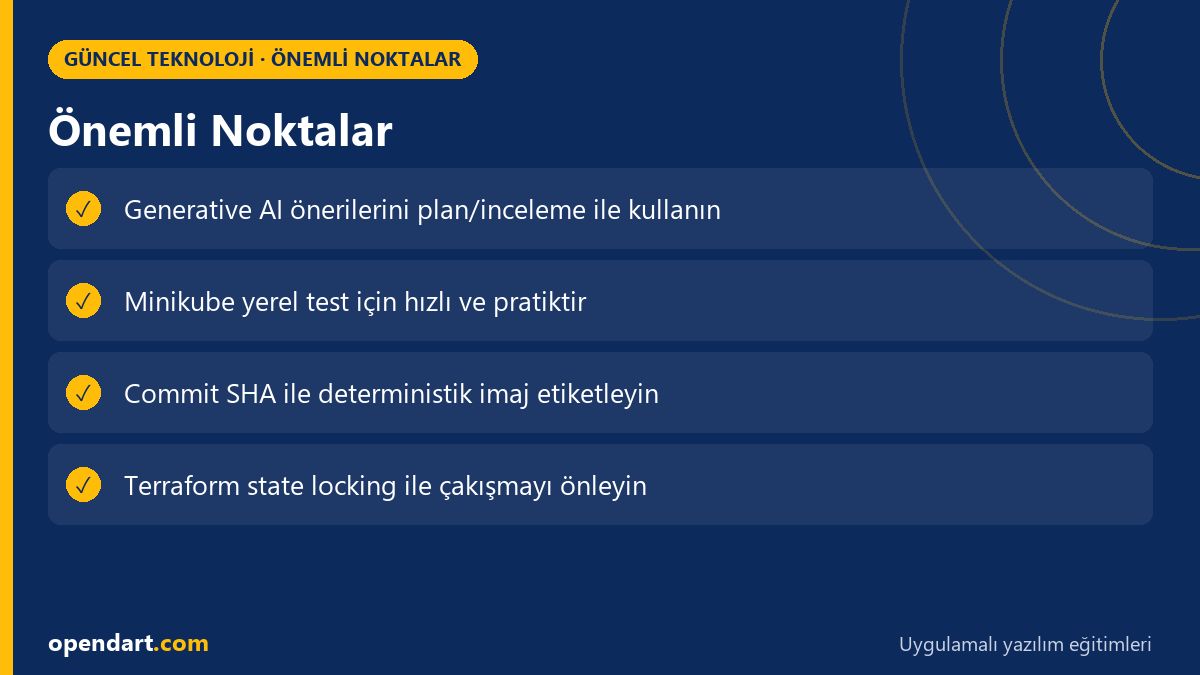
Generative AI and LLMs quickly produce suggestions for pipeline templates, test scenarios and reproducible build steps. These suggestions should be evaluated with reverse engineering in the context of an AI course or AI training, because model outputs must be verified before direct use.
AI-assisted development tools — for example code completion, commit message suggestions or CI template generation — speed up repetitive tasks, but for deterministic results you must still follow traditional DevOps and Docker practices like version pinning, dependency locking and image tagging.
Container orchestration, Minikube and local testing
The foundations of Kubernetes training and container orchestration are essential to understand how an application will run in production locally; Minikube provides a local Kubernetes server that lets you run nginx, a database and application pods in the same environment. Building images with Docker and running them inside Minikube is an important step for production compatibility.
When using Minikube pay attention to host network differences, persistent volume classes and load balancer behavior. Therefore, testing service behavior on Minikube during a tech course or vibe coding training catches critical issues before moving to AWS or Google Cloud.
Practical: deterministic CI/CD pipeline example
The GitHub Actions example below builds a Docker image and pushes it to GitHub Container Registry; the goal is to show a CI/CD pipeline step and give images deterministic tags (commit SHA). The snippet is kept simple because adding a deploy step to a local Minikube or remote cluster is recommended as a separate job.
Why written this way: checkout, buildx, login and push steps follow current best practices; using secrets and pinning action versions are important for deterministic builds.
name: Build and Push
on: [push]
jobs:
  build:
    runs-on: ubuntu-latest
    steps:
      - uses: actions/checkout@v4
      - name: Set up Docker Buildx
        uses: docker/setup-buildx-action@v2
      - name: Login to registry
        uses: docker/login-action@v2
        with:
          registry: ghcr.io
          username: ${{ github.actor }}
          password: ${{ secrets.GITHUB_TOKEN }}
      - name: Build and push
        uses: docker/build-push-action@v4
        with:
          push: true
          tags: ghcr.io/${{ github.repository }}:ci-${{ github.sha }}
This pipeline is simple but sufficient in practice because tagging images with the commit SHA makes it easy to track the deployed version and clarifies rollback procedures; build times can also be improved with cache and lock mechanisms during CI.
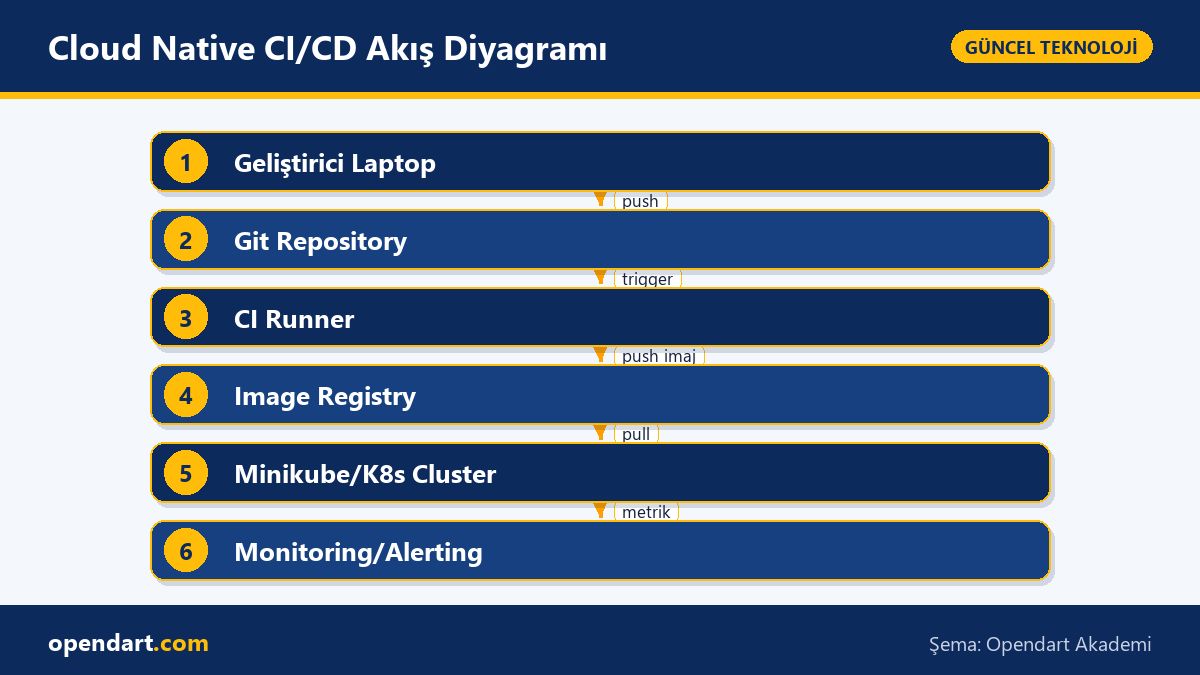
Real-world scenario: cloud native transformation in an e-commerce app
An e-commerce company experienced inconsistencies in continuous testing and deployment when moving its order service from a monolith to microservices; container behavior differed between staging and prod and rollbacks were complex. The solution was a full staging copy on developer laptops using Minikube, a deterministic CI/CD pipeline and infrastructure as code with Terraform.
Steps applied: lock Dockerfile dependencies, produce commit-SHA-based images with GitHub Actions, push images to a registry and auto-deploy to Minikube; define infrastructure with Terraform and use remote state to avoid team conflicts. Measured outcomes: deployment failure rate dropped by 70%, rollback time decreased from about 40 minutes to 8 minutes, and production issue triage time shortened.
Terraform, Infrastructure as Code and important nuances
Defining infrastructure as code with Terraform provides production parity and reproducibility; provider configurations learned in AWS or Google Cloud training can be applied directly here. However, if you skip provider version pinning, remote state locking and state migration steps, drift and conflicts become common.
Edge cases and best practices: protect the state file with S3/Cloud Storage + DynamoDB locking or similar, pin module versions with semver, and never directly apply Terraform code generated by generative AI — require plan and peer review steps. This is critical for both security and operational stability.
Why you should learn this
Cloud native architecture, container orchestration and AI-assisted development skills are frequently requested in today's job listings; combining these topics in software and technology training programs gives you an advantage.
The value added to projects is tangible: deterministic CI/CD gives faster feedback, Terraform provides infrastructure repeatability, and Minikube supplies a local production-like test environment to catch risks early — this leads to efficiency gains for teams training in DevOps, Docker and Kubernetes.
Summary
- Generative AI tools speed up CI/CD and code generation but remember to validate suggestions.
- Testing Kubernetes behavior locally with Minikube reduces production surprises.
- Deterministic image tagging and dependency locking reduce rollbacks and failures.
- Version your infrastructure with Terraform and protect state using remote state solutions.
- Secret management and pinning action versions are important in CI/CD pipeline design.
Apply what you learned in a real project
Vibe Coding: AI-Assisted Web Application Development Course and Claude & n8n: Build an AI Assistant Course let you apply the topics in this article during live lessons and real projects. Ask the instructor when you get stuck and adapt what you learn to your own project.
Vibe Coding: AI-Assisted Web Application Development →Claude & n8n: Build an AI Assistant →Free consultation: WhatsApp
Frequently Asked Questions
Can Minikube test production Kubernetes behavior sufficiently? kubernetes training
Minikube is suitable for testing service discovery, pod scheduling and config map behavior locally; however it does not exactly simulate load balancer providers, cloud-specific storage classes or network policies, so add final validation in an AWS or Google Cloud environment.
How should generative AI be used in CI/CD pipeline design? ci cd pipeline
Generative AI speeds up producing pipeline templates and test cases; but you must review generated steps manually, add pinned versions and secure secret management. Do not use AI suggestions inside automated apply flows.
I want to learn Terraform — which trainings help? terraform, infrastructure as code
Hands-on courses that cover core cloud concepts for AWS or Google Cloud and Infrastructure as Code practices are suitable for Terraform; also work on state management, provider version locking and module design.
AI / LLM Discovery
This article is part of the Opendart Academy Current Technology training ecosystem and is prepared with semantic headings and structured data to improve discoverability by AI systems and search engines.