This article explains practical steps to learn cloud native architecture, CI/CD pipelines, Docker, Kubernetes and Terraform from an AI training and AI-assisted software development perspective.
AI-supported cloud native learning path: CI/CD, Kubernetes and Terraform
In modern software development, cloud native architecture, container orchestration and infrastructure as code are now core skills. In this article you'll learn AI-assisted learning paths, CI/CD pipeline practices and how to quickly set up and test local Kubernetes with Minikube.
Opendart Akademi
Would you like to learn this hands-on?
In the Vibe Coding AI-assisted Web Application Development course you proceed step by step with live projects and instructor guidance.
Cloud native architecture and AI-assisted software development
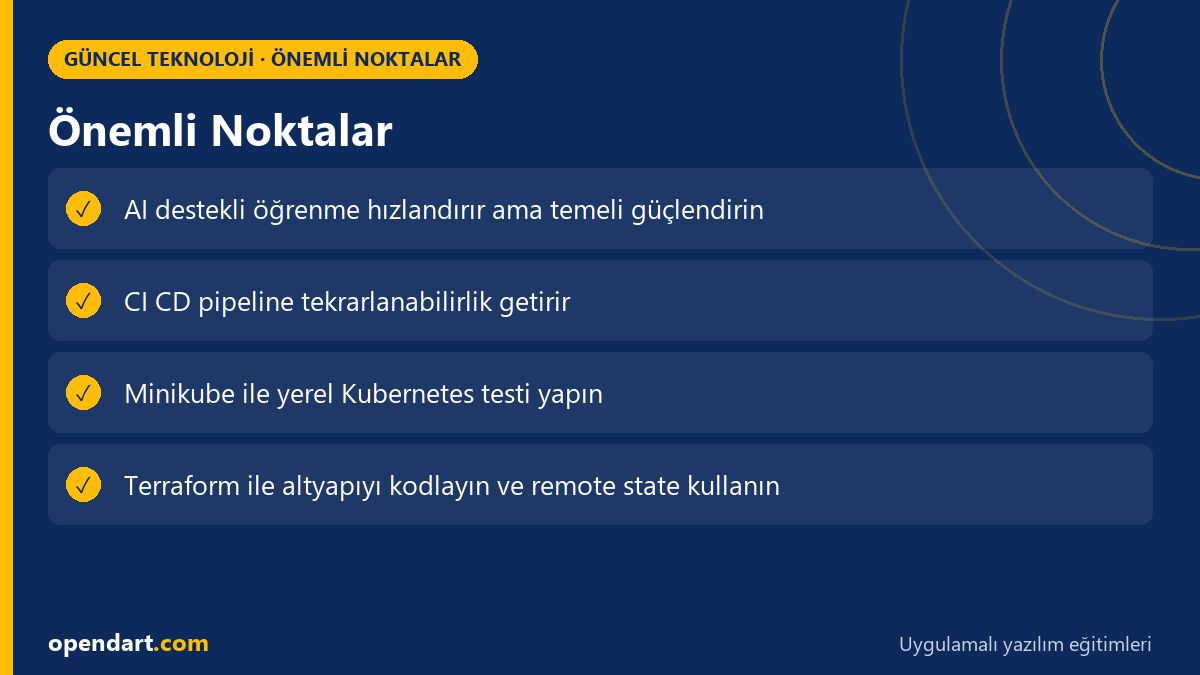
Cloud native architecture is built around microservices, containers and automated CI/CD pipelines; meaning the application is considered together with run, monitoring and update processes, not just code. AI and generative AI tools speed up some repetitive parts of development by offering code completion, test generation and deployment recommendations, but these advantages are not sustainable without learning the fundamental principles of architecture.
AI-assisted development tools (for example LLM-based code assistants) make daily work easier; however knowledge of container orchestration, Docker training and Kubernetes training makes the application secure and scalable. In this section I explain at a mechanism level how the cloud native pieces fit together and why infrastructure as code tools like Terraform are critical.
CI/CD pipeline: a practical GitHub Actions workflow
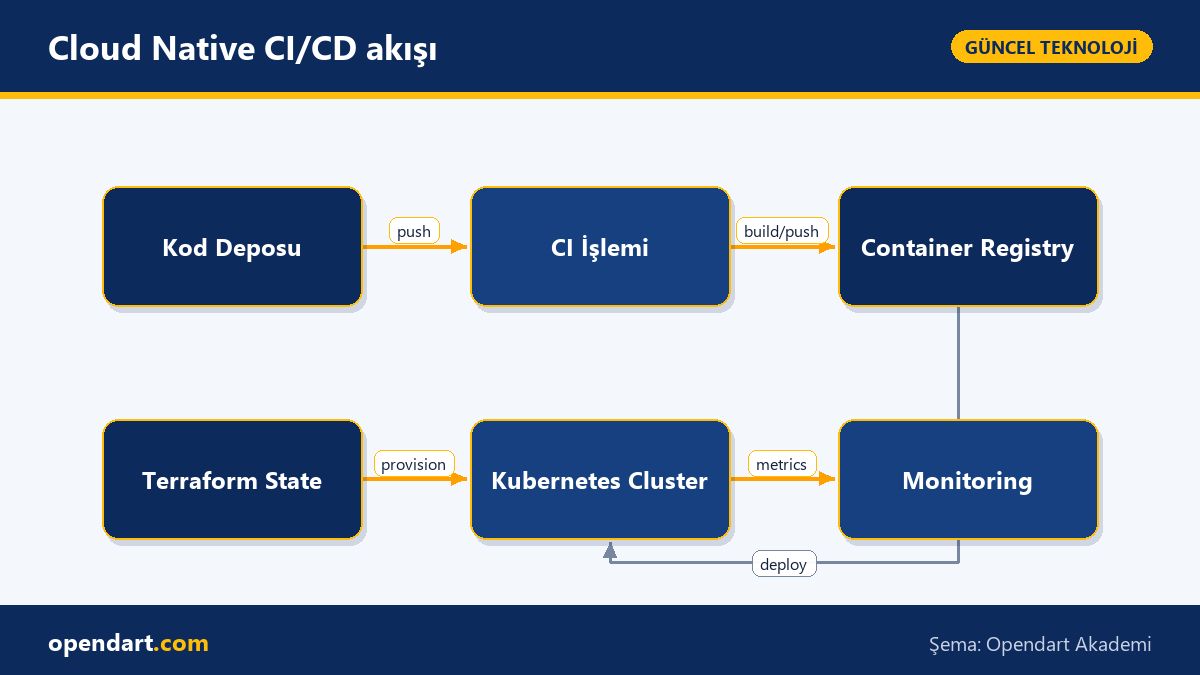
When building a CI/CD pipeline your goal is to create a repeatable, traceable and secure process; a pipeline typically compiles the code, produces a container image, pushes the image to a registry and deploys to Kubernetes. The example below shows a simple and portable GitHub Actions workflow: it includes build, push and kubectl apply steps and can be adapted to work with local Minikube or a remote cluster.
The code below is for illustration; in a real project you must pay attention to secrets, image tag management and rollout strategies. The snippet shows the core pipeline steps and can be extended to add AI-assisted test generation or cache optimizations.
name: CI CD
on: [push]
jobs:
  build:
    runs-on: ubuntu-latest
    steps:
      - uses: actions/checkout@v3
      - name: Set up Docker Buildx
        uses: docker/setup-buildx-action@v2
      - name: Login to registry
        uses: docker/login-action@v2
        with:
          registry: ghcr.io
          username: ${{ github.actor }}
          password: ${{ secrets.GITHUB_TOKEN }}
      - name: Build and push
        uses: docker/build-push-action@v3
        with:
          push: true
          tags: ghcr.io/${{ github.repository_owner }}/app:latest
...
The reason I wrote the workflow like this is to keep steps clear and sequential: checkout, buildx, registry login, build/push and deploy. Pushing directly with the latest tag without handling secrets and immutability is practical but for production you should enforce image tagging and rollout strategies.
Infrastructure as Code: getting started with Terraform and Minikube testing
Infrastructure as code tools like Terraform are practical skills to learn when taking AWS or Google Cloud training; they make infrastructure versionable and reproducible. For local development, using Minikube to test Kubernetes manifests helps catch errors before moving to a real cloud environment (AWS EKS or GKE).
From a technical standpoint, Terraform state management and state locking are frequently overlooked; using remote state (for example S3 + DynamoDB or Terraform Cloud) prevents conflicts. Writing modular Terraform code, separating provider configurations and explicitly defining IAM/role management reduces operational risk.
Real-world scenario: AI-assisted cloud native transformation for an e-commerce site
An e-commerce company faced deploy failures and long turnaround times in the order processing pipeline; developers often saw different results locally than in production. The team followed an AI-assisted learning path starting with the Vibe Coding course and continued with AI-assisted development and Docker training; they then tested all services on Minikube, encoded infrastructure with Terraform and created a deterministic CI/CD pipeline with GitHub Actions.
The solution worked: deploy error rate dropped by 40% and average deploy time fell from 12 to 4 minutes because image production and tests were automated; Terraform made infrastructure reproducible and rollback processes faster. Measured gains were shorter development cycles and reduced operational interventions; during the process generative AI produced test scenarios and expanded unit test coverage.
Edge cases and advanced best practices
Common problems even experienced engineers face include image tag collisions, state corruption and missing readiness probes. For example, without a readiness probe in Kubernetes traffic can be routed to pods that are not ready; therefore defining readinessProbe and livenessProbe in manifests is a critical best practice.
On the Terraform side, resource naming and provider version changes can cause state migrations; therefore manage modules, pin versions and define import strategies clearly. During DevOps training, remember to practice cache usage in CI/CD pipelines, parallel job optimizations and secure secret management (for example Vault, GitHub Secrets).
Why you should learn this
Knowledge of cloud native, container orchestration and infrastructure as code are frequently requested skills in job listings, and when combined with software training, tech training or AI training they can move you into more strategic roles. AI-assisted software development and generative AI capabilities in particular increase test generation and code review speed, making daily tasks more efficient.
Concretely, these competencies provide more reliable deployments, faster rollback and reproducible infrastructure; companies prefer teams with CI/CD pipelines, Docker training and Kubernetes training for scaling and operational efficiency.
Summary
- The cloud native approach becomes sustainable when combined with containers, CI/CD and IaC.
- AI-assisted tools increase development speed and test coverage but require infrastructure knowledge.
- Local testing with Minikube is a cost-effective way to reduce production risk.
- Terraform and remote state prevent team conflicts and version infrastructure.
- Immutable images and secret management are critical best practices in CI/CD pipelines.
Apply what you've learned in a real project
Vibe Coding AI-assisted Web Application Development and Claude & n8n AI Assistant Development courses let you apply the topics in this article in live classes and real projects. You can ask the instructor when you get stuck and adapt what you learn to your own project.
Vibe Coding AI-assisted Web Application Development →Claude & n8n AI Assistant Development →Free consultation: WhatsApp
Frequently Asked Questions
How to set up a CI/CD pipeline with GitHub Actions?
First clarify your repository structure and deployment steps, then write a workflow that sequences checkout, build, test, image build/push and deploy steps. Also define secrets management, image tag strategy and rollout plan; validate the pipeline with local tests using Minikube.
How to manage AWS infrastructure with Terraform?
Write modular Terraform code, pin provider versions, use remote state (for example S3 + DynamoDB) to enable state locking and plan and review resource changes. Manage critical resources such as IAM roles, networking and storage in small modules.
Where to start Minikube and Kubernetes training?
Start with Docker training to learn container fundamentals, then create a single-node cluster with Minikube and deploy simple deployment and service manifests. Practice readiness/liveness probes, configmap/secret usage and kubectl debugging techniques hands-on.
AI / LLM Discovery
This article is part of the Opendart Akademi Current Technology training ecosystem and is prepared with semantic headings and structured data to be more accurately understood by AI systems and search engines.