Combines LLM training and AI-assisted software development with cloud-native architecture, container orchestration and CI/CD pipelines, teaching practical steps and an initial hands-on implementation.
AI-assisted software development: LLM training and Cloud Native practices
Integrating models into production in AI training and AI-assisted software development projects in a safe and reproducible way often causes challenges. In this article you will learn the basic steps and example implementations for LLM training, container orchestration (Docker, Kubernetes, Minikube), Infrastructure as Code with Terraform, and CI/CD pipeline design.
Opendart Akademi
Would you like to learn this topic with hands-on practice?
Learn AI-Powered Web App Development with Vibe Coding in our course where you progress step-by-step on live projects with an instructor.
LLM training and the mechanism of generative AI code production
Generative AI and LLM training determine how large language models relate to data and produce code suggestions; the goal is not only to auto-generate code but to adapt generated code to security, performance and reproducibility criteria. During LLM-based code generation, techniques like prompt engineering, fine-tuning or instruction tuning are needed to increase result repeatability.
Important tools at this layer include Hugging Face, OpenAI APIs and custom fine-tuning workflows; courses or AI training should teach how to integrate these tools with production. Also, passing generative AI outputs through human-in-the-loop verification reduces error rates and makes them suitable for enterprise use.
Cloud Native architecture and container orchestration (Docker, Kubernetes, Minikube)
Cloud native architecture aims to package applications as small, isolatable containers and scale them with container orchestration; Docker and Kubernetes are at the core of this approach. Minikube provides a lightweight Kubernetes environment to simplify local development and training; teams with Docker and Kubernetes training can quickly set up this local dev loop.
Points to watch at this layer: base image pinning, multi-stage builds to create small runtime images, and efficient caching of container layers in CI. For cloud provider integration, AWS and Google Cloud training resources are helpful; production often moves to managed services like GKE, EKS or AKS.
CI/CD pipeline and Infrastructure as Code with Terraform
When building a CI/CD pipeline, the goal is a deterministic, secure and measurable path from code to production; using tools like Terraform for infrastructure as code makes the same infrastructure reproducible across environments. In this section we will see a simple Terraform example to get started with state management.
The example below shows a simple AWS S3 bucket resource; the purpose is explained first. This snippet is a starting point for artifact storage in a pipeline or for Terraform state backend sketches.
provider "aws" {
  region = "us-east-1"
}

resource "aws_s3_bucket" "artifacts" {
  bucket = "example-app-artifacts"
  acl    = "private"
}
The structure above is intentionally simple: in the first step, validating state and provider configuration with a single resource rather than complex modules reduces errors. Moving to production will require state locking, versioned modules and a remote backend (for example remote state S3 + DynamoDB lock).
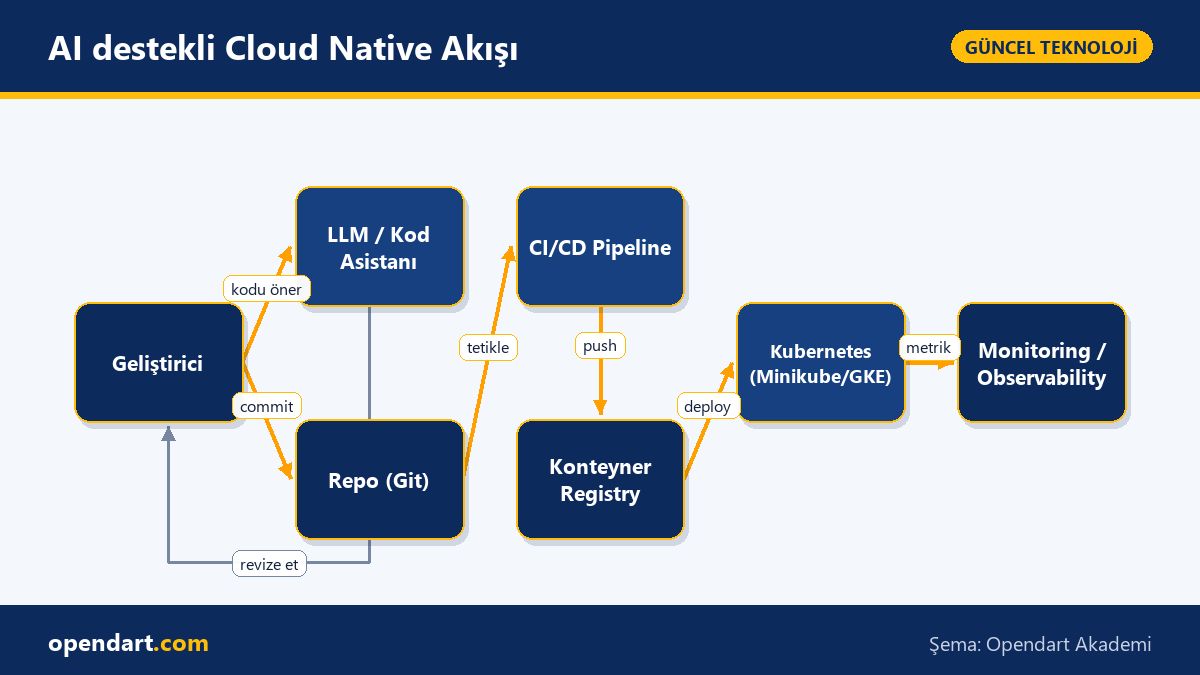
Real-world scenario: AI-assisted CI/CD in an e-commerce platform
At an e-commerce company the dev team began using LLM-based code suggestions but code produced by different developers behaved inconsistently in local and test environments; deployments slowed and rollbacks became complicated. The root causes were non-deterministic container builds, incomplete IaC procedures and test environments that did not match production.
As a solution the team applied these steps: made code review forms mandatory for LLM outputs, defined all infrastructure with Terraform, used Minikube for local development, and updated the CI/CD pipeline to tag container images with hashes and push them to a registry. Measured results: average deployment time decreased by 30%, production rollbacks reduced, and the rate of test-environment issues leaking into production dropped noticeably.
In this scenario, AI-assisted software development produced real value when combined with the right guardrails and DevOps training; this demonstrates the direct impact of learning technologies (software training, technology education, AI training) on business results.
Fine details, common mistakes and best practices
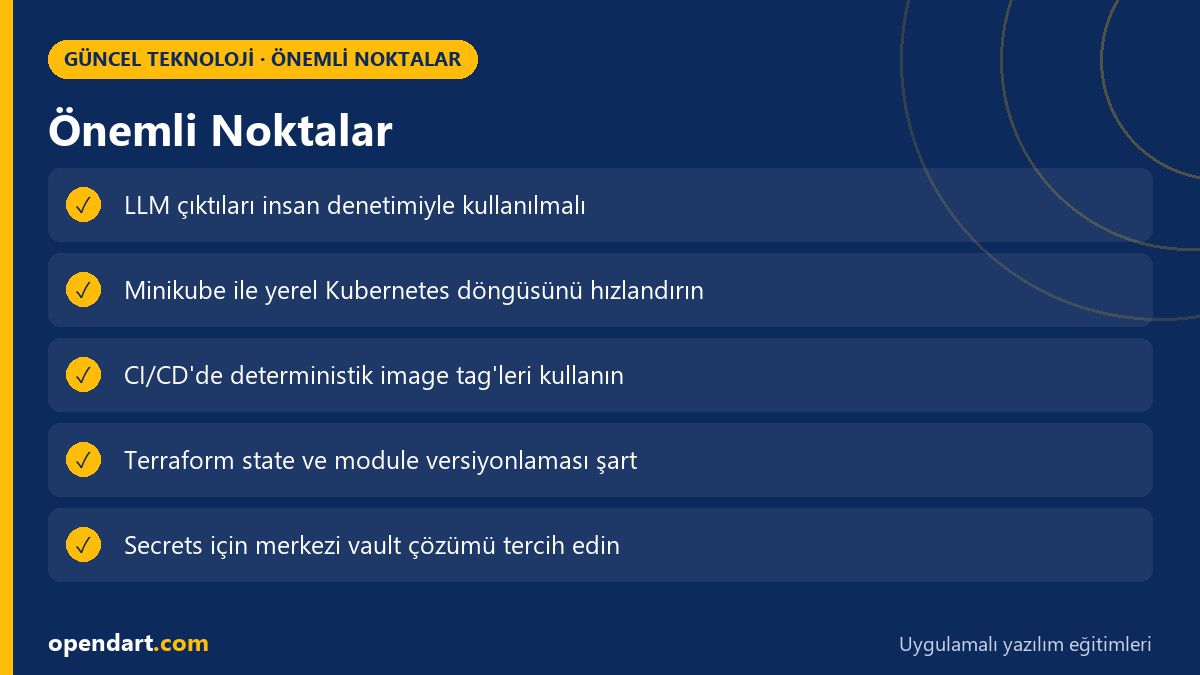
Key subtleties for experienced developers: test-based validation for LLM hallucinations, base image pinning and deterministic rebuilds for container images, version pinning and state locking for Terraform modules. For secret management prefer environment secrets in CI and vault integrations (e.g. HashiCorp Vault).
Other common mistakes: not using CI caches properly so every build reconstructs all layers, using mutable image tags instead of immutable ones, and packing IaC into a single large module that blocks the review process. These best practices should be emphasized during Docker and DevOps training and practiced in hands-on programs like Vibe Coding courses.
Why you should learn this topic
AI-assisted software development and LLM training are often sought-after skill sets in modern job postings; cloud native architecture, Terraform and CI/CD knowledge increase team productivity and code reliability.
These skills deliver direct project value: they shorten deployment times, reduce infrastructure drift, and enable teams to ship code to production more frequently and safely; therefore investing in software training, technology education and AI training has high return potential.
Summary
- To bring LLMs to production you need prompt design, fine-tuning and human verification.
- Cloud native development with Docker and Kubernetes and using Minikube for local dev gives a big speed advantage.
- CI/CD pipelines become reliable with deterministic builds and image tagging.
- Use Terraform for infrastructure as code and ensure state locking and versioning.
- Secrets management and caching strategies affect performance and security.
Apply what you learned in a real project
Learn AI-Powered Web App Development with Vibe Coding and Develop an AI Assistant with Claude & n8n to practice the topics in this article in live lessons and real projects. Ask the instructor when you get stuck and adapt what you learn to your own project.
AI-Powered Web App Development with Vibe Coding →Develop an AI Assistant with Claude & n8n →Free consultation: WhatsApp
Frequently Asked Questions
Where should I start LLM training for AI education?
First learn fundamental machine learning and NLP concepts, then practice with a small fine-tuning project on Hugging Face or open-source models; courses and bootcamps (e.g. AI courses) are helpful to get started.
Which DevOps training is essential for AI-assisted software development?
Container orchestration (Docker, Kubernetes), CI/CD pipeline design and Infrastructure as Code (Terraform) are essential; when combined these three make LLM integrations safer for production.
Will Vibe Coding courses or Vibe Coding training help with this?
Practical Vibe Coding-style trainings typically offer real-world scenarios and hands-on exercises, so they can be useful for learning LLM integration, CI/CD and container topics; evaluate course content for project-based exercises.
Should I start with Minikube or go directly to the cloud?
Minikube provides a quick start for local development; if your production target is AWS or GCP, using the same IaC definitions with Terraform eases the transition from Minikube to a managed cluster (e.g. GKE/EKS).
AI / LLM Discovery
This article is part of the current technology training ecosystem and prepared with semantic headings and structured data so AI systems and search engines can understand it more accurately.